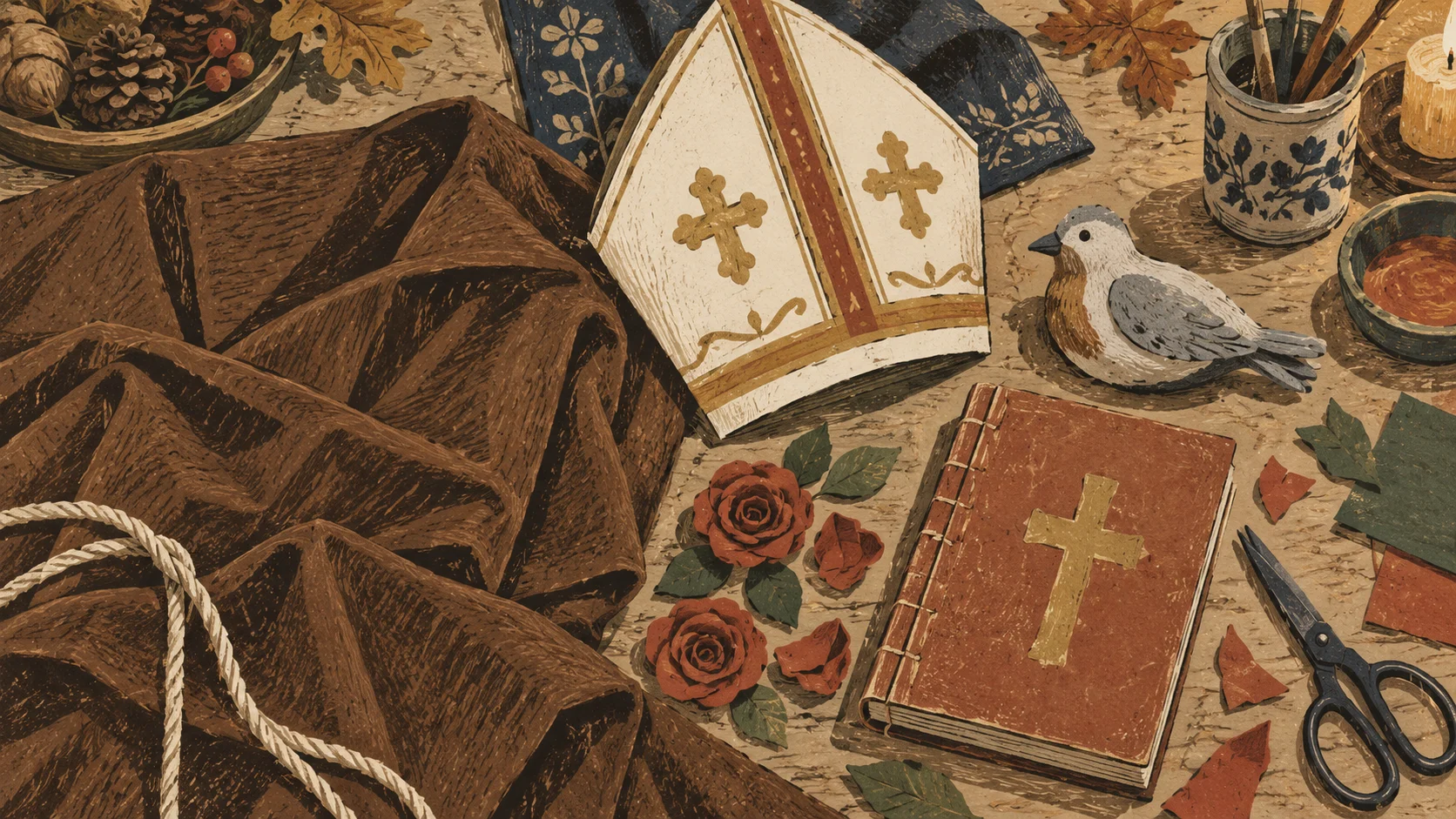
An All Saints Day costume can begin with a cardigan, a cardboard book, or a handful of paper flowers. The best costume gives a child one memorable way to talk about a saint. It does not need to look like a museum reconstruction or require a late-night shopping trip.
All Saints falls on Sunday, November 1, in 2026. These twelve ideas use ordinary household materials and a simple symbol. Let the child choose a saint they want to learn about, then help them prepare one sentence about that person’s life. For the wider celebration, see our three-day guide to Halloween, All Saints, and All Souls.
Twelve easy costume ideas
- St. Francis of Assisi: Wear a brown shirt or robe with a soft fabric belt and carry a stuffed bird. Talk about his love of Christ, poverty, and care for creation. The bird is a familiar artistic symbol, not the whole story of his life.
- St. Clare of Assisi: Use a plain dark dress or tunic with a light scarf loosely arranged as a veil. Carry a paper lantern to suggest prayerful attention to Christ. Keep the prop light and easy to put down.
- St. Joseph: Add a work apron to ordinary clothes and carry a cardboard carpenter’s square. Invite the child to name one way they can care for their family through useful work.
- St. Thérèse of Lisieux: Pair brown clothing with a simple veil and paper roses. Explain that small acts of love are worth taking seriously. The roses can become a gift for someone after the celebration.
- St. Nicholas: Make a paper bishop’s mitre and carry a pouch containing three large paper circles to represent gifts. A red cardigan or cloak is enough; elaborate vestments are unnecessary.
- St. Elizabeth Ann Seton: Use a dark dress or coat, a white scarf, and a small stack of books. Her role as an educator gives the child an easy connection to school and learning.
- St. Martin of Tours: Drape a short piece of fabric over one shoulder as a cloak. Make two matching paper cloak shapes to tell the traditional story of sharing with someone in need; no sword prop is necessary.
- St. Cecilia: Wear a favorite outfit and carry a paper musical note or a toy instrument. Explain that Cecilia is honored as a patron of music, rather than claiming that we know she played a particular instrument.
- St. Peter: Wear a simple tunic or oversized plain shirt and carry two large cardboard keys. Read a short Gospel passage involving Peter and discuss what it means to learn after making a mistake.
- St. Luke: Carry a notebook with a homemade cover and a pencil. The book can represent his Gospel. A simple artist’s palette is another traditional symbol, which you can explain as part of later Christian art.
- St. Marguerite Bourgeoys: Choose dark clothing, a light head covering, and a small slate or notebook. Introduce her as a teacher who helped build a learning community in Montreal.
- St. Juan Diego: Wear ordinary neutral clothing with a short cloth draped like a tilma and add paper roses. Focus on his faith and the Guadalupe tradition; avoid imitation skin tones or a generic “Indigenous” costume.
Make the costume comfortable and the story accurate
Choose clothing that allows easy walking, sitting, and bathroom breaks. Skip long cords, heavy props, sharp objects, and anything that blocks vision. A child who dislikes costumes can hold a saint picture or carry a symbol instead. No one needs to earn participation by dressing up.
Read a reliable short biography together before deciding what to say. The U.S. bishops’ introduction to saints explains the wider place of saints in Catholic life. Keep historical facts separate from familiar artistic symbols and later stories.
A one-sentence introduction
Try this pattern: “I chose St. ___ because ___, and one thing I can practice is ___.” That gives the costume a purpose beyond being recognized. After the event, put the craft supplies away and keep the one practice. A paper rose may last a day; the habit of remembering someone who needs kindness can last much longer.