
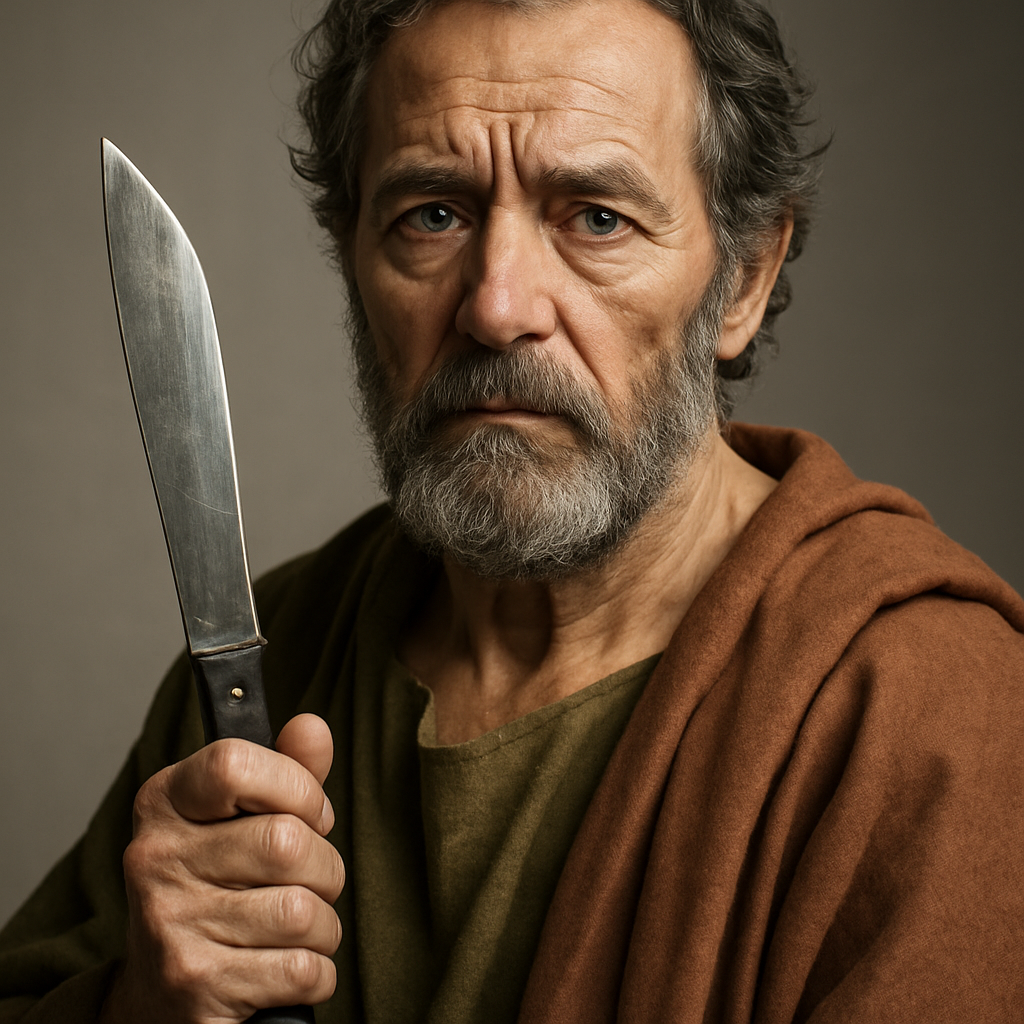
Among the twelve apostles chosen by Jesus Christ, Saint Bartholomew stands out as a figure of remarkable integrity, whose journey from initial skepticism to profound faith offers a powerful lesson for believers today. Often identified with Nathanael from the Gospel of John, Bartholomew’s story is one of a sincere heart quickly captivated by divine truth, leading him to embark on daring missionary journeys and ultimately to a heroic martyrdom. This article will delve into his life, from his historical context and calling to his enduring spiritual legacy, modern devotion, and practical reflections for our contemporary world.
Quick Facts
| Attribute | Detail |
|---|---|
| Birth | Cana of Galilee (1st century AD) |
| Death | Albanopolis, Armenia (1st century AD, traditionally by flaying) |
| Feast Day | August 24 |
| Patronage | Tanners, leather workers, butchers, neurologists, curriers, bookbinders, plasterers, shoemakers, tailors, cheese merchants, vine growers, Armenia |
| Canonized | As an Apostle, revered since ancient times |
Historical Context & Early Life
To understand Saint Bartholomew, we must first picture the world he inhabited. The land of Judea and Galilee in the first century AD was a crossroads of cultures, under the dominion of the Roman Empire, yet deeply rooted in its Jewish traditions. Roman rule, while maintaining a degree of order, was often seen as an oppressive foreign presence, sparking a simmering desire for a messianic liberator among the Jewish people.
Galilee, the region where Bartholomew was born, was often looked down upon by those in Jerusalem, considered somewhat provincial and less pious. It was a diverse area, bustling with farmers, fishermen, and merchants. This backdrop explains the comment attributed to Bartholomew (Nathanael) in the Gospel of John: “Can anything good come from Nazareth?” (John 1:46). Nazareth was a small, unremarkable town, and his skepticism reflected a common regional bias of the time.
While the New Testament gives us little detail about Bartholomew’s family background, his name, Bartholomew, is a patronymic, meaning “son of Tolmai.” This suggests his father’s name was Tolmai. The name Nathanael, which many scholars believe to be Bartholomew’s personal name, means “God has given.” This name might subtly hint at his character, a man given by God for a special purpose, or perhaps a reference to his sincere and God-fearing nature.
As a Jew living in Galilee, Bartholomew would have grown up immersed in the rich traditions of his faith. He would have learned the Torah, the Prophets, and the Psalms, attending synagogue services and observing the Jewish festivals. His understanding of the Messiah would have been shaped by these scriptures, and he likely harbored a deep longing for the redemption of Israel. This religious foundation provided fertile ground for his later encounter with Jesus, preparing his heart, despite initial doubts, to recognize the truth when it stood before him.
Calling & Key Milestones
St. Bartholomew’s life took an extraordinary turn with his call to follow Jesus, marking the beginning of his apostolic journey. His story, though brief in the Gospels, reveals much about his character and commitment.
The Encounter Under the Fig Tree
The most vivid account of St. Bartholomew’s calling comes from the Gospel of John, where he is identified as Nathanael. His friend Philip, after being called by Jesus, excitedly tells Nathanael, “We have found the one Moses wrote about in the Law, and about whom the prophets also wrote—Jesus of Nazareth, the son of Joseph” (John 1:45). Nathanael’s initial reaction, “Can anything good come from Nazareth?”, reveals a common prejudice, perhaps rooted in regional rivalry or a misunderstanding of messianic prophecies. However, Philip simply responds, “Come and see.”
This invitation, “Come and see,” is pivotal. It asks Nathanael to set aside his preconceptions and experience the truth for himself. As Nathanael approaches, Jesus utters a profound statement: “Here truly is an Israelite in whom there is no deceit” (John 1:47). This declaration immediately disarms Nathanael, who asks, “How do you know me?” Jesus’s response is even more astonishing: “I saw you while you were still under the fig tree before Philip called you” (John 1:48).
For Nathanael, being “under the fig tree” likely had a deeply personal significance. It was a common place for prayer, meditation, and study of the Torah, a place of quiet intimacy with God. Jesus’s knowledge of this private moment was a divine revelation, proving His supernatural insight. Overwhelmed by this divine perception, Nathanael immediately responds with a powerful confession of faith: “Rabbi, you are the Son of God; you are the King of Israel” (John 1:49). This is one of the earliest and most direct declarations of Jesus’s divinity and messianic kingship in the Gospels.
Apostolic Ministry and Missionary Journeys
Following his call, Bartholomew (Nathanael) became one of the twelve chosen apostles, frequently listed in the Gospels (Matthew 10:3, Mark 3:18, Luke 6:14) and the Acts of the Apostles (Acts 1:13). As an apostle, he would have spent years learning directly from Jesus, witnessing His miracles, hearing His teachings, and being prepared for the immense task of spreading the Gospel after the Resurrection and Pentecost.
After the ascension of Christ and the descent of the Holy Spirit, tradition holds that Bartholomew became a zealous missionary. Early Church historians and traditions provide accounts of his extensive travels, taking the Good News far beyond the borders of Judea. He is said to have preached in Mesopotamia, Persia, and Lycaonia. One significant tradition states that he traveled to India, bringing with him a copy of Matthew’s Gospel in Hebrew. This outreach to such distant lands highlights the profound commitment and courage of the early apostles.
Most famously, St. Bartholomew’s missionary work is associated with Armenia. He, along with St. Thaddeus, is credited with establishing Christianity in Armenia, laying the foundations for what would become the first nation to adopt Christianity as its official state religion. He converted many people, including the king’s brother, challenging pagan practices and idolatry.
Martyrdom and Enduring Witness
St. Bartholomew’s unwavering commitment to Christ ultimately led to his martyrdom. Tradition holds that he suffered a horrific death in Albanopolis, Armenia (which some scholars identify with modern-day Baku, Azerbaijan, or Darband, Dagestan, or more commonly believed to be in Armenia itself). Angered by the conversions and the threat to pagan worship, the local rulers ordered his execution. The most widely accepted account states that he was flayed alive—skinned—and then beheaded. This excruciating form of execution made him a powerful symbol of ultimate sacrifice and steadfast faith.
His brutal martyrdom solidified his place in Christian memory as a courageous witness to the truth of Christ, willing to endure unimaginable suffering rather than renounce his Lord. His relics were later moved, with significant portions eventually residing in Benevento, Italy, and his skull in the Basilica of San Bartolomeo all’Isola in Rome, where they continue to be venerated by the faithful.
Spiritual Legacy & Theological Themes
St. Bartholomew’s journey from an initially skeptical questioner to a martyred apostle leaves a rich spiritual legacy, offering profound theological themes and virtues for all Christians.
Virtues Exemplified
Sincerity and Lack of Deceit: Jesus’s profound words, “Here truly is an Israelite in whom there is no deceit!” (John 1:47), define Bartholomew’s primary virtue. He was honest, direct, and transparent. His initial skepticism about Nazareth wasn’t malicious but a genuine question. This sincerity allowed him to be truly open to the truth once it was revealed, making him a model for intellectual honesty and genuine seeking.
Profound Faith and Openness to Truth: Despite his initial question, Bartholomew did not stubbornly cling to his preconceptions. When confronted with Jesus’s divine knowledge, he immediately recognized Him as the Son of God and King of Israel. This quick, unwavering confession highlights a heart that, while analytical, was ultimately humble and ready to embrace truth, even when it challenged his worldview. His faith was not superficial but deeply rooted once conviction took hold.
Zeal for Evangelization: His extensive missionary journeys, reaching distant lands like India and Armenia, demonstrate an extraordinary zeal for spreading the Good News. He was not content to keep the message of salvation to himself but bravely ventured into unknown and often hostile territories, driven by the Great Commission.
Courage in Suffering: St. Bartholomew’s ultimate sacrifice through flaying and beheading is the strongest testament to his courage and unwavering fidelity to Christ. He faced excruciating pain and death rather than deny his faith, embodying the ultimate witness (martyrdom itself means “witness”).
Lasting Influence
St. Bartholomew’s influence resonates through various aspects of Catholic life and tradition:
Liturgy and Devotion: His feast day on August 24th is celebrated throughout the universal Church, honoring his place among the apostles. He is invoked as an intercessor, particularly for those in the professions related to his martyrdom (tanners, leatherworkers) and for those seeking honesty and courage in their faith.
Art and Iconography: St. Bartholomew is one of the most distinctly recognizable saints in art, almost always depicted with a flaying knife and often holding his own skin, symbolizing his horrific martyrdom. This powerful imagery serves as a constant reminder of the cost of discipleship and the unwavering faith of the apostles. Famous works by artists like Michelangelo (in the Sistine Chapel) portray him vividly, embedding his story in the collective consciousness of Christianity.
Theological Reflection: His story, particularly the encounter under the fig tree, offers fertile ground for theological reflection on the nature of truth, divine omniscience, and the transformation of initial doubt into profound conviction. Jesus’s praise of his sincerity challenges us to examine our own hearts for any “deceit” or hidden motives, encouraging a pure and honest pursuit of God.
Patronage: His patronage extends to a wide array of professions, particularly those involving knives or skin. Beyond these specific crafts, he also serves as a patron for Armenia, a testament to his foundational missionary work in that nation.
Devotion Today
Devotion to St. Bartholomew continues to thrive around the world, though perhaps less universally recognized than some other apostles, his specific story resonates deeply within particular communities and traditions.
The most significant center of devotion to St. Bartholomew is the Basilica of San Bartolomeo all’Isola (St. Bartholomew-in-the-Island) in Rome. This ancient church, located on Tiber Island, houses what are believed to be the major relics of his skull. Pilgrims visit this site to venerate the apostle and seek his intercession. The atmosphere there is one of quiet contemplation and reverence for one of Christ’s earliest and most courageous followers. The church itself has a rich history, rebuilt and modified over centuries, serving as a continuous testament to his enduring legacy.
Another important site for his relics and veneration is the cathedral in Benevento, Italy, where a large portion of his body is said to be interred. These relics were transferred there in the 9th century, marking a significant event in medieval relic veneration and further cementing his place in the piety of Southern Italy.
Given his traditional missionary work, St. Bartholomew is also highly venerated in Armenia. He is considered, along with St. Thaddeus, one of the founding apostles of the Armenian Apostolic Church, which holds him in profound esteem. Numerous churches and monasteries in Armenia are dedicated to him, and his influence is deeply woven into the national Christian heritage.
Annual celebrations on his feast day, August 24th, are observed globally. In many Catholic communities, this day is marked by special Masses, prayers, and sometimes processions. For the guilds and professions under his patronage—such as tanners, leather workers, and butchers—this day might involve specific gatherings or blessings. In some agricultural regions, particularly those involved with vineyards, his feast day is also observed, connecting to an aspect of his patronage.
While not a saint typically associated with grand pilgrimages like Santiago de Compostela, St. Bartholomew’s memory is kept alive through local devotions, the naming of churches, and the constant presence of his powerful imagery in Christian art, inviting believers to reflect on the nature of true faith and unwavering courage.
Reflections for Modern Readers
The life of St. Bartholomew, though lived two millennia ago, offers timeless lessons and actionable takeaways for contemporary Catholics navigating a complex world. His journey from doubt to unwavering faith, and his ultimate sacrifice, provide a profound spiritual compass.
-
Embrace Sincerity and Seek Truth (Even When Uncomfortable): Jesus’s commendation, “an Israelite in whom there is no deceit,” is a powerful call to integrity. In an age often marked by superficiality, spin, and outright falsehoods, Bartholomew challenges us to be genuinely honest in our search for truth, even if it means questioning our own assumptions or popular narratives. Like him, we should be willing to “come and see” rather than dismiss truth based on prejudice or hear-say.
Real-world example: When encountering a new idea or a teaching of the Church that challenges your understanding, instead of immediately dismissing it or uncritically accepting it, take the time to research it with an open mind, seeking genuine understanding and praying for discernment, just as Bartholomew allowed Jesus to reveal a deeper truth to him.
-
Turn Skepticism into Inquiry and Faith: Bartholomew’s initial question, “Can anything good come from Nazareth?”, wasn’t a closed-minded rejection but an honest expression of doubt. His willingness to “come and see” transformed his skepticism into a profound, immediate confession of faith. This teaches us that doubt, when handled sincerely, can be a pathway to deeper faith, rather than an obstacle. It’s okay to have questions, but we must bring them to Christ and allow Him to answer.
Real-world example: If you struggle with doubts about God’s existence or the Church’s teachings, don’t just push them aside or let them fester. Instead, approach them like Bartholomew: openly confess your doubts, seek answers through prayer, study, spiritual direction, or honest conversation with faithful people, and be open to God’s revelation.
-
Be a Courageous Witness: St. Bartholomew’s missionary journeys and his ultimate martyrdom underscore the importance of bold witness for Christ. He traveled far and wide, enduring hardship and danger, ultimately giving his life for the Gospel. In our own lives, we are called to be witnesses in our daily interactions, through our words, actions, and the very way we live. This doesn’t always mean grand gestures, but consistently living out our faith.
Real-world example: You might be the only Christian witness some of your friends or colleagues encounter. Sharing your faith might involve speaking up for Christian values in a respectful way, offering a kind word of encouragement, praying for someone in need, or simply living a life of joy and integrity that draws others to ask about your hope.
-
Embrace the Cost of Discipleship: Bartholomew’s brutal martyrdom serves as a stark reminder that following Christ can come at a great personal cost. While most of us won’t face physical flaying, we may be called to “die to ourselves” daily—to sacrifice personal desires, popularity, or comfort for the sake of the Gospel. His life encourages us to embrace this cross, knowing that true life is found in Christ.
Real-world example: Choosing to uphold ethical standards in a competitive work environment when it might cost you a promotion, or sacrificing personal time and resources to serve those in need, are modern forms of embracing the cost of discipleship. It’s about putting Christ’s teachings above personal gain or comfort.
Symbols and Representations
St. Bartholomew is one of the most vividly depicted saints in Christian art, and his symbols tell the story of his life and martyrdom:
- The Knife (or Knives): This is his primary and most recognizable attribute. It symbolizes the instrument of his martyrdom—the flaying knife used to strip his skin. In art, he is often shown holding a large knife, or several knives might be present near him. This stark image serves as a powerful reminder of his suffering and ultimate sacrifice.
- Flayed Skin: Perhaps the most striking and unforgettable symbol, St. Bartholomew is often depicted holding or draped with his own flayed skin. This gruesome but historically significant detail directly represents the manner of his death. Michelangelo’s famous depiction in the Sistine Chapel’s “Last Judgment” shows Bartholomew holding his skin, which is said to bear a self-portrait of Michelangelo himself. This symbol emphasizes his complete identification with Christ’s suffering.
- Book or Scroll: This symbol represents his identity as an apostle, a bearer of the Gospel message. It signifies his role in preaching the Good News and his commitment to the Word of God. Sometimes, it specifically represents the Gospel of Matthew, which tradition says he carried to India.
These symbols, while graphic, are not meant to glorify violence but to commemorate the extreme fidelity of a man who chose Christ over life itself, offering powerful lessons on conviction, truth, and martyrdom.
Timeline Summary
- Early 1st Century AD: Born in Cana of Galilee, likely named Nathanael.
- c. 30 AD: Encountered Jesus, introduced by Philip, and immediately confessed Jesus as the Son of God and King of Israel after Jesus revealed His divine knowledge.
- c. 30-33 AD: Served as one of the twelve apostles, learning directly from Jesus during His public ministry.
- c. 33 AD onwards: Embarked on extensive missionary journeys after the Resurrection and Pentecost.
- Mid-1st Century AD: Preached the Gospel in Mesopotamia, Persia, Lycaonia, and most notably, Armenia, where he is considered a founder of the Church.
- Mid-1st Century AD: Martyred in Albanopolis, Armenia, traditionally by being flayed alive and then beheaded for his faith.
- 9th Century AD: His relics were transferred to Benevento, Italy.
- 10th Century AD: A portion of his relics, including his skull, was transferred to the Basilica of San Bartolomeo all’Isola in Rome.
- August 24: His feast day, celebrated annually by the Catholic Church.
Scripture for Reflection
St. Bartholomew’s story, particularly his calling, is most vividly captured in the Gospel of John, offering profound insights into his character and Jesus’s divine knowledge.
John 1:43-51 (NABRE)
“The next day he decided to go to Galilee, and he found Philip. And Jesus said to him, ‘Follow me.’ Now Philip was from Bethsaida, the town of Andrew and Peter. Philip found Nathanael and told him, ‘We have found the one about whom Moses in the law and also the prophets wrote, Jesus son of Joseph, from Nazareth.’ But Nathanael said to him, ‘Can anything good come from Nazareth?’ Philip said to him, ‘Come and see.’ Jesus saw Nathanael coming toward him and said of him, ‘Here is a true Israelite. There is no duplicity in him.’ Nathanael said to him, ‘How do you know me?’ Jesus answered and said to him, ‘Before Philip called you, I saw you under the fig tree.’ Nathanael answered him, ‘Rabbi, you are the Son of God; you are the King of Israel.’ Jesus answered and said to him, ‘Do you believe because I told you that I saw you under the fig tree? You will see greater things than this.’ And he said to him, ‘Amen, amen, I say to you, you will see the sky opened and the angels of God ascending and descending on the Son of Man.'”
This passage is central to understanding St. Bartholomew. Jesus’s praise, “There is no duplicity in him,” highlights his sincerity and honesty—a truly virtuous quality. His initial skepticism is quickly overcome by Jesus’s divine insight, leading to his profound and immediate confession of faith. This teaches us the importance of approaching truth with an open heart, allowing God to reveal Himself, and responding with unwavering belief.
Prayers to St. Bartholomew
Prayer to Saint Bartholomew
O glorious Saint Bartholomew, who was privileged to behold the Lord Jesus and to know Him as the Son of God and King of Israel, grant us also the grace to recognize Jesus in our lives and to follow Him with sincerity and zeal. Through your intercession, strengthen our faith, that we may overcome all doubts and prejudices, and with courage, proclaim the Gospel to all nations, even in the face of suffering and adversity. May your example inspire us to live lives free from deceit, always seeking and embracing the truth. Amen.
A Shorter Invocation
Saint Bartholomew, pray for us!





