Welcome to the inspiring life of Saint Ignatius of Loyola, a remarkable figure whose dramatic conversion transformed him from a worldly soldier into a spiritual master and the visionary founder of the Society of Jesus, also known as the Jesuits. His journey offers timeless lessons on finding God’s purpose in our lives, even amidst adversity. This article will explore his early life and radical conversion, key moments in his spiritual journey, his profound legacy on Catholic thought and mission, how devotion to him continues today, and practical insights for modern believers. We’ll also provide a timeline of his life, relevant Scripture for reflection, and prayers associated with this influential saint.
Quick Facts
| Category | Detail |
|---|---|
| Birth | 1491, Azpeitia, Kingdom of Castile (modern-day Spain) |
| Death | July 31, 1556, Rome, Papal States |
| Feast Day | July 31 |
| Patronage | Society of Jesus (Jesuits), soldiers, spiritual retreats, educators, Basque Country |
| Canonized | March 12, 1622, by Pope Gregory XV |
Historical Context & Early Life
Born Íñigo López de Loyola in 1491, Saint Ignatius entered the world at a time of immense change and upheaval. The late 15th and early 16th centuries were a period of intense exploration, scientific discovery, and profound religious shifts in Europe. Christopher Columbus had recently reached the Americas, the Renaissance was in full bloom, and the rumblings of the Protestant Reformation were beginning to challenge the established religious order.
Loyola Castle, his birthplace in the Basque region of Spain, reflected his noble lineage. Íñigo was the youngest of 13 children, born into a prominent family with strong ties to royalty and the military. From a young age, he was steeped in the chivalric traditions of his era, dreaming of military glory and courtly love. He was known for his dashing appearance, his skill with a sword, and a certain impulsiveness that often led him into duels and conflicts. His early life was marked by worldly ambition, a desire for fame, and a focus on earthly honors rather than spiritual pursuits.
As a young man, Íñigo pursued a career as a soldier and courtier. He reveled in the pomp and ceremony of court life and the excitement of battle. He was a man of his time, deeply engaged with the secular world, yet his story would soon take an unexpected and dramatic turn, forever changing not only his own life but also the course of Catholic history.
Calling & Key Milestones
Saint Ignatius’s path to sainthood began with a life-altering experience that redirected his worldly ambitions toward a profound spiritual quest. His “calling” wasn’t a gentle whisper but a violent jolt that forced him to confront his life’s true direction.
The Conversion at Pamplona
In May 1521, Íñigo was defending the fortress of Pamplona against a French siege. During the battle, a cannonball struck his leg, shattering it and ending his military career in an instant. This painful injury, and the subsequent agonizing surgeries and slow recovery at his family’s castle, became the crucible of his conversion. Confined to his bed, he requested books of chivalry, but none were available. Instead, he was given a copy of the “Life of Christ” and a collection of “Lives of the Saints.” As he read, something profound began to shift within him.
He noticed a stark difference in his feelings. Reading about worldly heroes and adventures left him temporarily excited but ultimately empty. Reading about Christ and the saints, however, brought a lasting peace and joy, even after he put the books down. This simple observation led him to a groundbreaking spiritual insight: different thoughts and desires lead to different spiritual fruits. He began to “discern” – to sort through – these inner movements, recognizing which led him closer to God and which pulled him away. This process of introspection laid the groundwork for his famous “Spiritual Exercises.”
Manresa and the Spiritual Exercises
After his recovery, Íñigo renounced his former life. He made a pilgrimage to the Shrine of Montserrat, confessed his sins, and exchanged his fine clothes for a beggar’s sackcloth, laying his sword before a statue of the Virgin Mary. He then spent nearly a year (1522-1523) living in a cave near the town of Manresa, Spain. This period was one of intense prayer, fasting, and profound spiritual experiences, including visions and deep insights into the mysteries of faith. It was during this time that he began to compile his observations and methods for spiritual growth, which would eventually become the “Spiritual Exercises.” This guide, developed from his own personal journey, aims to help individuals find God’s will for their lives and commit more deeply to Christ.
Pilgrimage to the Holy Land and Early Ministry
Following his time in Manresa, Ignatius (as he was now often called) felt a strong call to visit the Holy Land, to walk where Jesus walked. He traveled to Jerusalem in 1523, intending to stay and dedicate his life there. However, the Franciscan guardians of the holy sites advised him to return to Europe due to safety concerns. Obediently, he returned, realizing that his mission was not to be a solitary pilgrim but to help others find God.
Studies and Companions
Ignatius quickly realized that to effectively “help souls” – his new guiding principle – he needed a formal education. At the age of 33, he began studying Latin alongside schoolboys in Barcelona, enduring ridicule and poverty. He then moved on to universities in Alcalá, Salamanca, and eventually Paris, where he studied philosophy and theology. Despite facing suspicion from the Inquisition (who questioned his unconventional spiritual methods), he persevered.
In Paris, he gathered around him a small group of like-minded students, including Francis Xavier, Peter Faber, and others. They were drawn to Ignatius’s spiritual fervor and his unique way of helping them connect with God. On August 15, 1534, in a small chapel in Montmartre, Paris, these seven companions made vows of poverty and chastity and promised to go to Jerusalem to serve God. If that proved impossible, they vowed to offer themselves to the Pope for whatever mission he deemed necessary.
Founding of the Society of Jesus
When their plan to go to the Holy Land became impossible due to ongoing conflicts, Ignatius and his companions offered their services to Pope Paul III in Rome. On September 27, 1540, the Pope formally approved the “Society of Jesus” (Societas Iesu), or the Jesuits, with the papal bull “Regimini militantis Ecclesiae” (“To the Government of the Church Militant”). Ignatius was elected as the first Superior General in 1541. Under his leadership, the Jesuits became a powerful force for the Catholic Church, focusing on education, missionary work, and direct service to the Pope. Ignatius spent the rest of his life in Rome, guiding the nascent order, writing its Constitutions, and sending his companions across the globe to preach, teach, and minister, truly becoming “God’s vanguard.”
Spiritual Legacy & Theological Themes
Saint Ignatius of Loyola left an indelible mark on Catholic spirituality, theology, and the Church’s global mission. His insights continue to shape how countless individuals encounter God and live out their faith.
At the heart of Ignatian spirituality is the concept of discernment of spirits. This isn’t about fortune-telling, but a disciplined process of prayerful reflection to understand the origin and direction of one’s thoughts, feelings, and desires. Ignatius taught that by paying close attention to these “spirits” – the inner movements that lead to either consolation (peace, joy, closeness to God) or desolation (anxiety, sadness, distance from God) – one can better discern God’s will and resist negative influences. This practical approach helps believers make choices that align with God’s loving plan, fostering a deeper, more intentional relationship with the divine.
Another foundational Ignatian theme is “finding God in all things.” This principle challenges the idea that God is only found in churches or during formal prayer. Instead, Ignatius taught that God’s presence and action can be encountered in every aspect of life – in work, relationships, nature, culture, and even challenges. This perspective elevates the ordinary, transforming daily activities into opportunities for prayer and encountering the sacred. It fosters a contemplative yet active spirituality, encouraging a deeper appreciation for creation and a greater awareness of God’s constant engagement with the world.
The famous motto of the Society of Jesus, A.M.D.G. (Ad Majorem Dei Gloriam), which translates to “For the Greater Glory of God,” encapsulates the driving force behind Ignatian spirituality. This isn’t about God needing our glory, but about humans fulfilling their purpose by orienting every action, thought, and word toward praising and serving God more fully. It promotes a zealous and generous spirit, striving for excellence in all endeavors as an offering to God.
Ignatius’s most significant spiritual contribution is undoubtedly the Spiritual Exercises. This structured series of meditations, contemplations, and prayers is designed to help a person purify their soul, overcome disordered attachments, and align their will with God’s. Often experienced in a guided retreat setting, the Exercises lead individuals through a profound encounter with the life of Christ, inviting them to respond generously to God’s call to love and service. They have been a transformative tool for countless individuals seeking deeper conversion and a clearer sense of purpose.
Beyond individual spirituality, Ignatius infused the Jesuit order with a unique charism for education and mission. Recognizing the power of the mind to serve God, he emphasized intellectual rigor and academic excellence. Jesuit schools and universities rapidly became renowned centers of learning, attracting students from across the globe. Furthermore, his vision extended to the far corners of the earth; the Jesuits became pioneering missionaries, bringing the Gospel to new lands in Asia, Africa, and the Americas, often at great personal risk. This dual focus on intellectual formation and global evangelization profoundly influenced the Counter-Reformation and the spread of Catholicism worldwide.
Finally, Ignatius instilled in his order a special vow of obedience to the Pope, emphasizing direct service to the Holy See. This commitment to the universal Church and its visible head ensured that the Jesuits were always ready to go wherever the Pope needed them most, serving on the front lines of evangelization and theological defense. This unique relationship further strengthened the Papacy during a turbulent period in Church history.
Devotion Today
Centuries after his death, devotion to Saint Ignatius of Loyola remains strong and vibrant, particularly within the Society of Jesus and among those who have been touched by Ignatian spirituality. His feast day, July 31, is celebrated worldwide, especially in Jesuit institutions and parishes.
The most enduring form of devotion to Saint Ignatius today is through the continued practice and spread of his Spiritual Exercises. Thousands of people each year participate in guided retreats, both in their full 30-day form and in shorter adaptations (like the “19th Annotation” retreat, done over many months in daily life). These retreats are offered at Jesuit retreat centers and by spiritual directors trained in Ignatian methods across the globe, inviting individuals to a profound encounter with God and a deeper understanding of their personal vocation.
Jesuit institutions, including universities, colleges, and high schools, serve as living monuments to Ignatius’s vision for education. These schools, found on every continent, continue to embody the Ignatian ideal of holistic formation, emphasizing not only academic excellence but also the development of “men and women for others” – individuals committed to justice, service, and spiritual growth. Alumni and students often develop a strong sense of pride and connection to Ignatian values.
Shrines and pilgrimage sites also continue to draw pilgrims. The Loyola Sanctuary in Azpeitia, Spain, built around his birthplace, is a major pilgrimage destination, allowing visitors to walk in the footsteps of the young Íñigo. In Rome, the Church of the Gesù, the mother church of the Society of Jesus, houses his tomb and remains a focal point for Jesuit life and prayer.
Beyond formal institutions, many individuals and groups find inspiration in Ignatian concepts like discernment, “finding God in all things,” and the “Magis” (Latin for “the more,” referring to striving for the greater glory of God). These ideas are integrated into daily prayer, spiritual direction, and community service, making Ignatian spirituality accessible and relevant for everyday Catholics seeking a deeper spiritual life.
Reflections for Modern Readers
Saint Ignatius’s life, though lived centuries ago, offers powerful and practical lessons for anyone navigating the complexities of the 21st century. His journey from worldly ambition to profound holiness provides a blueprint for a meaningful life centered on God.
- Transforming Adversity into Opportunity: Ignatius’s conversion began with a devastating injury. What seemed like the end of his life’s dreams became the catalyst for a much greater, more fulfilling path. For us, this means seeing challenges, setbacks, and even failures not as roadblocks, but as potential doorways to new growth, deeper self-understanding, and unexpected divine guidance. When faced with job loss, illness, or personal crisis, can we ask, “What is God trying to show me here? How can this difficult experience lead to something greater?”
- The Power of Intentional Discernment: In our fast-paced, noisy world, we’re constantly bombarded with choices and demands. Ignatius’s emphasis on discernment encourages us to slow down, to listen to our inner movements – our feelings, thoughts, and desires – and to notice where they lead us. This isn’t about agonizing over every decision, but about developing a spiritual sensitivity to recognize God’s gentle invitations and promptings in our lives. For example, before making a significant life decision like choosing a career path or a relationship, we can prayerfully reflect: “Does this choice bring me a lasting peace and joy? Does it align with my deepest values and call to serve God and others?”
- Finding God in the Everyday: We often compartmentalize our faith, reserving it for Sundays or formal prayer times. Ignatius’s “finding God in all things” challenges us to see the sacred in the mundane. The morning commute, doing dishes, a conversation with a colleague, even scrolling through social media – all can become opportunities to connect with God’s presence. This means cultivating a mindset of gratitude, wonder, and mindful attention to the small details of life, recognizing God’s hand at work in every moment, no matter how ordinary.
- Lifelong Learning and Growth: Ignatius, a proud soldier, humbly went back to school in his 30s, recognizing he needed knowledge to serve God better. This reminds us that spiritual and personal growth is a lifelong journey. We are called to continually learn, adapt, and grow, not just intellectually, but spiritually and emotionally. This might mean reading spiritual books, attending faith formation classes, seeking spiritual direction, or simply committing to daily quiet reflection to better understand ourselves and God.
- A Faith That Leads to Action: Ignatian spirituality is not passive contemplation; it is dynamic and leads to generous service. Ignatius didn’t just have profound spiritual experiences; he channeled them into founding a world-changing order dedicated to education, evangelization, and justice. For us, this means ensuring our faith isn’t just a private feeling but translates into concrete actions that benefit others and build God’s Kingdom. How can our prayer lead us to serve our community, advocate for the marginalized, or simply be more loving and compassionate in our daily interactions?
Symbols and Representations:
- The Cannonball or Broken Leg: This powerful symbol represents the literal injury Ignatius sustained at Pamplona, which was the turning point in his life. It signifies the transformative power of adversity and how God can use even our most painful experiences to lead us to a deeper calling.
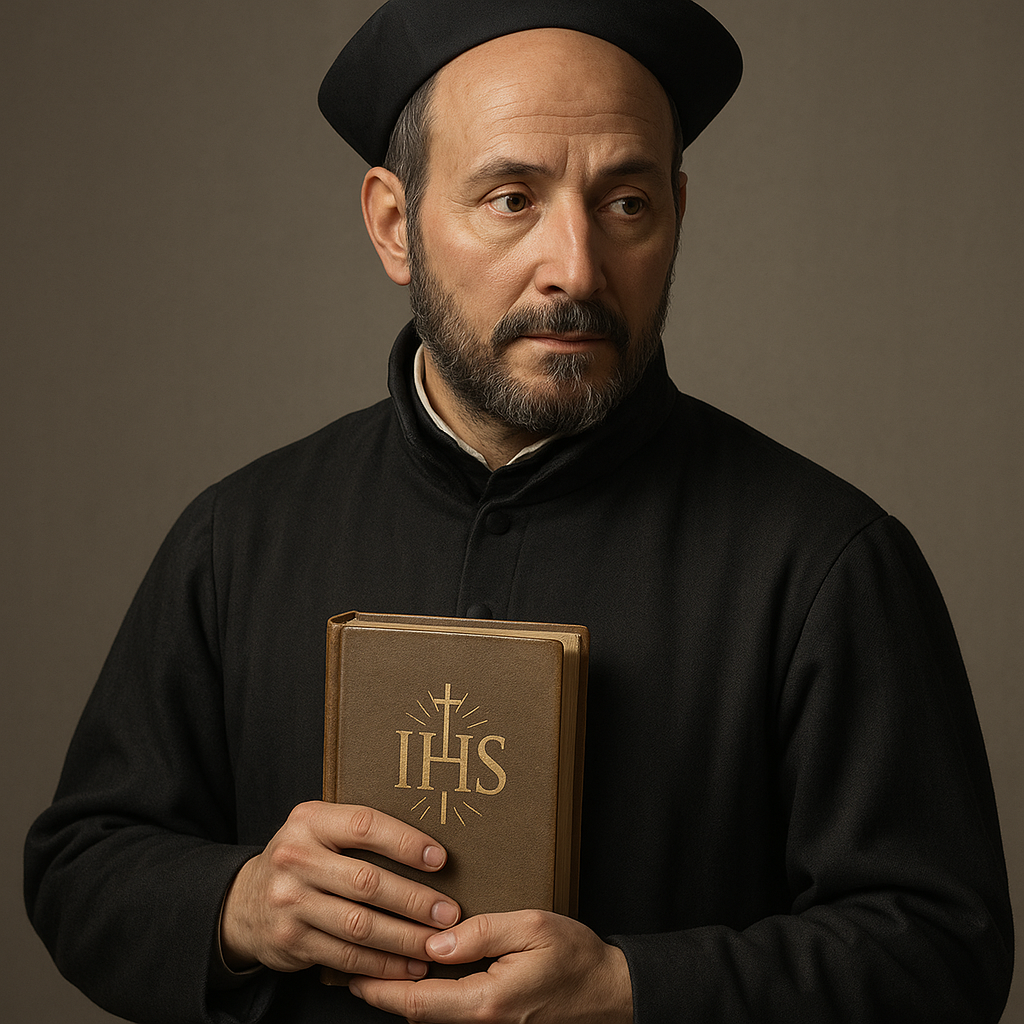
- A Book (often with IHS): Ignatius is frequently depicted holding or looking at a book, symbolizing the spiritual reading (the Lives of the Saints and the Life of Christ) that ignited his conversion. The book also represents his authorship of the Spiritual Exercises and the Jesuit emphasis on intellectual pursuit and education. The letters IHS are a Christian monogram representing the name of Jesus (from the first three Greek letters of his name, Iota-Eta-Sigma), which became a prominent symbol for the Society of Jesus.
- A Sword (sometimes discarded): Reflecting his early life as a soldier, Ignatius is sometimes shown with a sword, either in his hand or being laid down. When discarded, it symbolizes his renunciation of worldly military glory for spiritual warfare in Christ’s service.
- Flames or a Heart Ablaze: These represent the intense spiritual fervor and divine love that consumed Ignatius after his conversion, especially during his time at Manresa. They signify his profound mystical experiences and the passionate devotion he cultivated.
Timeline Summary
- 1491: Born Íñigo López de Loyola in Azpeitia, Kingdom of Castile (modern-day Spain).
- 1506-1517: Serves as a page and then a soldier, embracing a worldly and chivalric lifestyle.
- 1521 (May): Wounded by a cannonball during the Siege of Pamplona; begins his spiritual conversion during a long, painful recovery.
- 1522-1523: Retreats to Manresa, spending nearly a year in deep prayer and developing the foundational ideas for his “Spiritual Exercises.”
- 1523 (September): Embarks on a pilgrimage to the Holy Land.
- 1524: Returns to Spain and begins formal studies in Barcelona, Alcalá, and Salamanca, despite being much older than most students.
- 1528: Moves to Paris to continue his studies, where he gathers his first companions.
- 1534 (August 15): With six companions, including Francis Xavier and Peter Faber, takes vows of poverty, chastity, and a pilgrimage to Jerusalem in Montmartre, Paris.
- 1537 (June 24): Ordained a priest in Venice, Italy.
- 1539: The companions decide to form a new religious order, the Society of Jesus.
- 1540 (September 27): Pope Paul III formally approves the Society of Jesus (Jesuits) with the papal bull “Regimini militantis Ecclesiae.”
- 1541 (April 19): Ignatius is elected as the first Superior General of the Society of Jesus.
- 1548: The “Spiritual Exercises” receive formal papal approval from Pope Paul III.
- 1556 (July 31): Dies in Rome at the age of 64, having overseen the rapid growth of the Jesuit order.
- 1609: Beatified by Pope Paul V.
- 1622 (March 12): Canonized a saint by Pope Gregory XV, alongside Saints Francis Xavier, Teresa of Avila, Isidore the Laborer, and Philip Neri.
Scripture for Reflection
Saint Ignatius’s life and spirituality resonate deeply with several key Scripture passages that illuminate his core virtues and transformative journey:
- Matthew 16:24: “Then Jesus told his disciples, ‘If anyone would come after me, let him deny himself and take up his cross and follow me.'”
This verse perfectly encapsulates Ignatius’s radical conversion. He literally laid down his sword and embraced a life of self-denial and total commitment to Christ. His spiritual journey was a profound “taking up his cross” – turning away from worldly glory to follow the humble path of Jesus, enduring hardship and criticism for the sake of the Gospel.
- Philippians 2:5-8: “Have this mind among yourselves, which is in Christ Jesus, who, though he was in the form of God, did not count equality with God a thing to be grasped, but emptied himself, taking the form of a servant, being born in the likeness of men. And being found in human form, he humbled himself by becoming obedient to the point of death, even death on a cross.”
This passage beautifully reflects the spirit of the Society of Jesus, founded on a deep humility and obedience patterned after Christ. Ignatius emphasized becoming “servants of Christ” and “servants of the Church,” echoing Christ’s own self-emptying love and perfect obedience to the Father’s will, even to the point of suffering.
- 1 Corinthians 10:31: “So, whether you eat or drink, or whatever you do, do all to the glory of God.”
This verse is the biblical foundation for the Jesuit motto, “Ad Majorem Dei Gloriam” (For the Greater Glory of God). It captures Ignatius’s vision of “finding God in all things,” where every action, no matter how small or mundane, can be offered to God as an act of worship and service. It inspires believers to live a life of intentionality, where every moment becomes an opportunity to glorify God.
Prayers to Saint Ignatius of Loyola
Prayer for Generosity (attributed to St. Ignatius)
Dearest Lord, teach me to be generous;
teach me to serve You as You deserve;
to give and not to count the cost;
to fight and not to heed the wounds;
to toil and not to seek for rest;
to labor and not to ask for any reward,
save that of knowing that I do Your most Holy Will. Amen.
Prayer for Discernment
O Saint Ignatius, pattern of penitence and spiritual discernment,
you experienced a profound conversion from a life of worldly ambition to one consumed by love for God.
Teach us, we pray, to truly listen to the stirrings of our hearts,
to recognize the voice of God amidst the many voices of the world.
Help us to discern God’s will in our daily lives,
to choose what leads to deeper peace and greater glory for Him.
Inspire us to courageously follow Christ,
to seek Him in all things, and to serve Him with generous hearts.
Through your intercession, may we always strive for the greater glory of God.
Amen.