
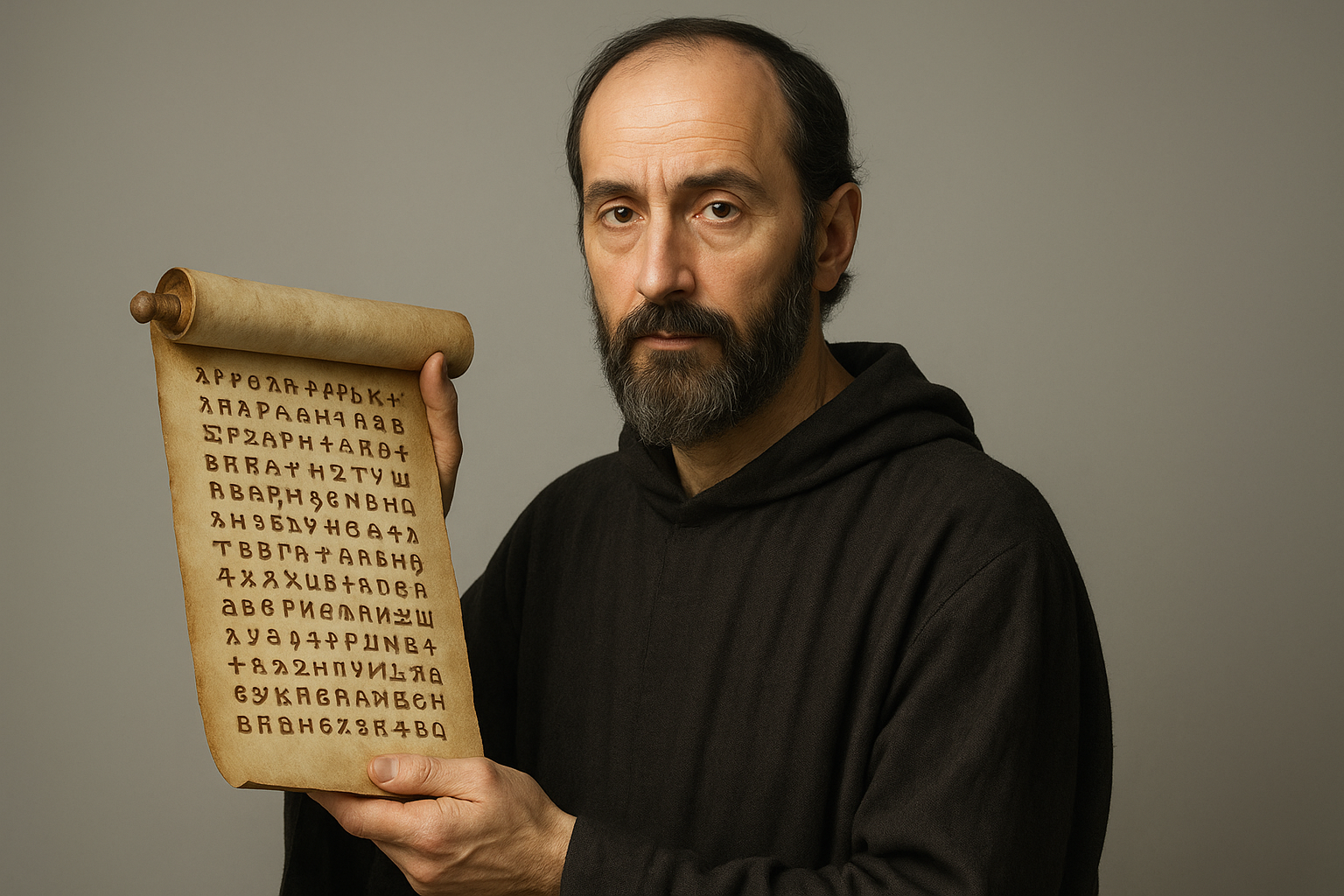
In the vast tapestry of Catholic history, few figures shine as brightly or with as much transformative power as Saints Cyril and Methodius. These two brothers, born into the grandeur of the Byzantine Empire, became intrepid missionaries who ventured into uncharted spiritual territories, forever changing the course of Christianity for millions. Their legacy is not just one of evangelization, but of profound cultural innovation, demonstrating how the Gospel can take root and flourish in new languages and traditions. This article will explore their remarkable early lives, the divine call that led them to the Slavic lands, their groundbreaking work in creating a new alphabet and liturgy, and the enduring spiritual lessons they offer to modern believers.
Quick Facts
| Attribute | Detail |
|---|---|
| Birth | St. Methodius: c. 815 (Thessalonica, Byzantine Empire) St. Cyril: c. 826/827 (Thessalonica, Byzantine Empire) |
| Death | St. Cyril: February 14, 869 (Rome, Papal States) St. Methodius: April 6, 885 (Great Moravia) |
| Feast Day | February 14 |
| Patronage | Europe, Ecumenism, Slavic peoples, Missionaries, Translators, Scholars, Unity of Christians. |
| Canonized | Recognized as saints by popular veneration and officially confirmed through their universal veneration. Declared co-patrons of Europe by Pope John Paul II in 1980. |
Historical Context & Early Life
The 9th century was a pivotal time for Europe, marked by the ongoing clash and blending of cultures, the rise of new kingdoms, and intense religious ferment. The powerful Byzantine Empire, with its capital in Constantinople, stood as a beacon of Christian civilization in the East, while the Holy Roman Empire was emerging in the West. Between these two giants lay vast territories inhabited by various Slavic tribes, many of whom were still practicing pagan religions. These tribes, including the Bulgars, Serbs, Croats, and Moravians, were often caught in the political and religious rivalries of their more powerful neighbors. Both Eastern (Byzantine) and Western (Frankish/Roman) missionaries were active, each seeking to bring these peoples into their respective spheres of influence, often through the Latin or Greek languages.
It was into this dynamic world that Saints Cyril and Methodius were born in Thessalonica, a vibrant city in the Byzantine Empire. Thessalonica was a bustling port city with a significant Slavic population, meaning the brothers would have grown up hearing not only Greek, but also various Slavic dialects. Their family was prominent and well-connected; their father, Leo, was a high-ranking officer in the Byzantine military. They were seven brothers in total, and Methodius was the eldest, while Cyril, originally named Constantine, was the youngest.
Methodius, whose birth name was Michael, initially followed a career path similar to his father’s. He served in the Byzantine administration and even became the governor of a Slavic-speaking province, giving him invaluable experience in governance and an intimate understanding of Slavic culture and language. This period of his life provided practical skills and insights that would prove crucial for his later missionary work.
Cyril, the younger brother, was a brilliant scholar from an early age. He was sent to Constantinople for his education, where he quickly distinguished himself. He studied at the renowned Magnaura School, an imperial institution, alongside the future Emperor Michael III. He mastered subjects like grammar, rhetoric, philosophy, theology, astronomy, and languages. His exceptional intellect earned him the nickname “the Philosopher.” After completing his studies, he was ordained a deacon, became a professor of philosophy at Magnaura, and held important positions, including librarian at Hagia Sophia, the great cathedral of Constantinople. Both brothers were men of profound faith and intellectual prowess, uniquely prepared by God for the monumental task that awaited them.
Calling & Key Milestones
The Khazar Mission
The first major missionary assignment for Cyril came in the early 860s, a testament to his reputation as a brilliant scholar and theologian. The Khazars, a powerful Turkic people whose rulers were considering converting to Judaism, Christianity, or Islam, requested a Christian scholar to debate with Jewish and Muslim representatives. The Byzantine Emperor Michael III chose Cyril for this delicate diplomatic and theological mission. Methodius, who by then had retired to a monastery, accompanied his brother, serving as an advisor and helper. This mission, though not directly to Slavic peoples, honed Cyril’s skills in interfaith dialogue and adapting the Christian message to different cultural contexts. He successfully defended Christian tenets against the arguments of other religions, though the Khazar rulers ultimately chose Judaism.
The Moravian Mission Begins
The true turning point in the brothers’ lives, and in the history of the Slavic peoples, came in 862. Prince Rastislav of Great Moravia, a powerful Slavic kingdom located in Central Europe, sent an urgent request to Emperor Michael III. Rastislav sought missionaries who could preach the Gospel to his people in their own language. Frankish (Latin-speaking) missionaries had already been active in Moravia, but Rastislav wanted to establish a native clergy and liturgy, free from foreign political influence. He understood that for Christianity to truly take root, it had to speak to the hearts of his people in their mother tongue. The Emperor, remembering Cyril’s success with the Khazars and knowing the brothers’ fluency in Slavic dialects from their Thessalonican upbringing, immediately recognized them as the ideal candidates. He tasked them with this mission, famously telling them, “You are Thessalonians, and all Thessalonians speak pure Slavonic.”
Developing the Glagolitic Alphabet
Upon arriving in Moravia, Cyril and Methodius faced a monumental challenge: the Slavic language had no written script. How could they translate the Gospels, liturgical texts, and other Christian writings without an alphabet? Cyril, with his profound linguistic and philosophical expertise, undertook the incredible task of creating one. He developed what is now known as the Glagolitic alphabet. This was not a mere transcription; it was a complex and ingenious system designed specifically to capture the nuances of the Slavic phonetics. The Glagolitic script was a completely new invention, unique in its forms and deeply rooted in Christian symbolism, making it distinctly Slavic rather than simply an adaptation of Greek or Latin. This innovative act allowed the brothers to translate the most important liturgical books – the Gospels, the Psalter, and other sacred texts – into Old Church Slavonic, the first literary language of the Slavs.
Defending the Slavonic Liturgy
Their work, however, was not without fierce opposition. The Frankish clergy, who had already established themselves in Moravia and used Latin in their liturgy, vehemently opposed the use of Slavonic. They adhered to the “Trilingual Heresy,” the belief that God could only be praised in three sacred languages: Hebrew, Greek, and Latin, the languages inscribed on the cross of Christ. Cyril and Methodius bravely defended their revolutionary approach, arguing that God understands all languages and that the Gospel should be accessible to all peoples in their native tongue. Their innovative practice of celebrating Mass and other sacraments in Slavonic was a radical departure from the norm in Western Europe and sparked considerable controversy.
Papal Approval and Methodius’s Consecration
To defend their work and seek official authorization for the Slavonic liturgy, the brothers traveled to Rome in 867. They were received by Pope Adrian II, who, after careful examination of their translations and explanation of their mission, recognized the profound value of their work. In a landmark decision, the Pope not only approved the use of Slavonic in the liturgy but also placed the translated books on the altar of Santa Maria Maggiore, blessing them and demonstrating full papal endorsement. He also ordained some of their Slavic disciples as priests. During this time, Cyril’s health began to fail. He felt his end was near and became a monk, taking the name Cyril (his original name was Constantine). He died in Rome on February 14, 869, at the age of 42, asking his brother to continue their mission.
Methodius as Archbishop
After Cyril’s death, Methodius returned to Moravia, now consecrated an archbishop by Pope Adrian II, with jurisdiction over the Slavic territories. He continued their mission, translating more texts and establishing a native clergy. However, the opposition from the Frankish clergy intensified. He was even imprisoned for a time, enduring harsh conditions, before Pope John VIII intervened to secure his release. Despite constant harassment, political turmoil, and theological disputes, Methodius persevered. He traveled extensively, evangelized the Bulgarians, and continued to spread the Slavonic liturgy. His unwavering commitment to his brother’s vision, even in the face of immense suffering, highlights his incredible strength and faith.
Cyril’s Death in Rome
St. Cyril, as mentioned, died in Rome in 869. His final resting place is in the Basilica of San Clemente, where his tomb remains a place of pilgrimage and veneration. His legacy as the intellectual architect of the Slavic mission, the creator of Glagolitic, and a brilliant theologian, was cemented in his early passing. It was a testament to his vision that Methodius, burdened by grief but strengthened by faith, carried on their shared calling.
Spiritual Legacy & Theological Themes
The spiritual legacy of Saints Cyril and Methodius is vast and multifaceted, rooted deeply in foundational Catholic teachings and exemplified by their extraordinary virtues. Their lives perfectly illustrate a core principle of the Gospel: that Christ’s message is universal and meant for all peoples, in all languages, and all cultures.
Inculturation and Adaptability: Perhaps their most significant contribution was their pioneering work in inculturation. Before them, missionaries often brought not just the Gospel but also their own language and culture. Cyril and Methodius understood that for the faith to truly penetrate the hearts of the Slavic peoples, it had to speak their language, literally and figuratively. By creating the Glagolitic alphabet and translating the liturgy and Scriptures into Old Church Slavonic, they affirmed the dignity of Slavic culture and language. This act prefigures the Second Vatican Council’s emphasis on adapting the liturgy and catechesis to local cultures, demonstrating that the Church is truly catholic, meaning universal.
Missionary Zeal and Perseverance: Both brothers possessed an unshakeable missionary zeal, a burning desire to share the Good News of Jesus Christ. They left behind lives of comfort and prominence to face the hardships of evangelization, political intrigue, and physical suffering. Methodius’s perseverance after Cyril’s death, enduring imprisonment and constant opposition, is a powerful testament to his unwavering faith and commitment to their shared mission. They exemplify the call to go forth and make disciples of all nations, as Christ commanded.
Intellectual Excellence at the Service of Faith: Cyril’s intellectual brilliance was not for self-aggrandizement but was entirely dedicated to serving God and the Church. His creation of the Glagolitic alphabet is a prime example of how human intellect, when guided by faith, can achieve truly extraordinary things for the glory of God. They remind us that faith and reason are not opposed but complementary, and that intellectual pursuit can be a profound form of worship and evangelization.
Unity and Ecumenism: Though living centuries before the modern ecumenical movement, Cyril and Methodius are often seen as prototypes of Christian unity. Born in the East, serving under the patronage of the Byzantine Emperor, yet receiving papal approval for their work in the West, they embodied a bridge between the Eastern and Western traditions. Their legacy continues to inspire efforts to heal the divisions within Christianity, reminding us of a time when East and West worked in profound harmony for the spread of the Gospel. Pope John Paul II declared them co-patrons of Europe, precisely for their role as spiritual bridge-builders between East and West.
Theological Themes: Their work emphasized the accessibility of divine revelation. By translating the Scriptures, they promoted the idea that God’s word is not meant for a select few, but for every believer. Their defense of the vernacular liturgy also highlighted the incarnational aspect of Christianity – that God enters into human reality, including human language and culture, to reveal Himself. Their lives underscore the importance of witness, courage, and scholarly rigor in spreading the Kingdom of God.
Devotion Today
Devotion to Saints Cyril and Methodius remains vibrant, especially among Slavic peoples and throughout Europe. They are universally recognized as pivotal figures in the history of Christianity. Their feast day is celebrated on February 14th in the Roman Catholic Church, and also by Orthodox Churches, though often on different dates reflecting their respective calendars.
As co-patrons of Europe, declared by Pope John Paul II in 1980 (alongside St. Benedict), they are seen as spiritual architects uniting the continent, particularly its Eastern and Western halves. This patronage highlights their enduring significance for European identity and Christian unity.
Many churches and institutions, particularly in Central and Eastern Europe, are dedicated to their names. Pilgrimages are made to significant sites associated with them, such as the Basilica of San Clemente in Rome, where St. Cyril is buried. His tomb there is a revered pilgrimage destination for many, especially those from Slavic countries.
In countries like Slovakia, Czech Republic, Bulgaria, Croatia, Serbia, and North Macedonia, they are celebrated with great fervor. National holidays are often observed in their honor. In many places, their work is commemorated through academic conferences, cultural festivals, and religious services that emphasize their role in establishing national literary traditions and Christian faith. Their legacy is a constant reminder of the Church’s universal mission and the power of inculturation.
Reflections for Modern Readers
The lives of Saints Cyril and Methodius offer a wealth of actionable takeaways and profound lessons that resonate deeply in the 21st century:
- Embrace Cultural Sensitivity and Inculturation: In an increasingly globalized world, we encounter diverse cultures and perspectives daily. Cyril and Methodius teach us the importance of understanding and respecting others’ cultural contexts when sharing the Good News or engaging in dialogue. Rather than imposing our own cultural forms, we are called to discern how the timeless message of Christ can be expressed authentically within different traditions. For a modern Christian, this might mean learning about a new neighbor’s background, supporting mission work that respects local customs, or even simply adapting our communication style to better connect with people from different walks of life.
- Persevere in the Face of Opposition: The brothers faced relentless opposition, misunderstanding, and even imprisonment, yet they never gave up on their mission. Their story reminds us that living out our faith and pursuing God’s call will often involve challenges. When faced with criticism, setbacks, or societal pressure against our beliefs, their example encourages us to stand firm with courage and trust in God’s plan. This could apply to a student defending their faith in a secular environment, a professional upholding ethical standards, or anyone striving to live a virtuous life against current trends.
- Value Education and Intellectual Pursuit in Service of Faith: Cyril, “the Philosopher,” demonstrated how rigorous intellect can be a powerful tool for evangelization. In an age of information overload and complex questions, we are called to deepen our understanding of our faith, not just to believe, but to comprehend and articulate. Whether through reading theological texts, engaging in thoughtful discussion, or simply reflecting deeply on Scripture, investing in intellectual growth strengthens our faith and equips us to share it more effectively.
- Be Bridge-Builders for Unity: As figures who transcended the growing East-West divide, Cyril and Methodius are powerful symbols of unity. In a world often fractured by political, social, and religious differences, their lives call us to seek common ground, foster understanding, and work towards reconciliation. This can manifest in small ways, like reaching out to someone with different views, or in larger efforts to promote dialogue and healing within communities and between Christian denominations. Their legacy is a hopeful reminder that true Christian charity seeks to unite, not divide.
Symbols and Representations: In art, Saints Cyril and Methodius are most commonly depicted holding books or scrolls, often inscribed with Glagolitic or early Cyrillic script, symbolizing their groundbreaking work in creating a written language for the Slavs and translating sacred texts. They are frequently shown together, emphasizing their fraternal bond and collaborative mission. Sometimes, they hold models of churches or crosses, representing their role in establishing Christianity among the Slavic peoples. Cyril might be shown with a pen or quill, highlighting his scholarly and linguistic genius. Methodius is often depicted with an archbishop’s pallium or crosier, indicating his episcopal office and leadership. These symbols remind us of their unique contributions to faith, language, and culture.
Timeline Summary
- c. 815: Birth of Michael (Methodius) in Thessalonica.
- c. 826/827: Birth of Constantine (Cyril) in Thessalonica.
- Early Life: Both brothers receive excellent education; Methodius serves in Byzantine administration, Cyril studies in Constantinople and becomes a professor of philosophy.
- c. 860: Cyril (accompanied by Methodius) undertakes the Khazar mission.
- 862: Prince Rastislav of Moravia requests missionaries from the Byzantine Emperor.
- 863: Saints Cyril and Methodius arrive in Great Moravia, begin their mission, and Cyril creates the Glagolitic alphabet.
- 863-867: They translate liturgical books and Scripture into Old Church Slavonic and establish a native clergy.
- 867: The brothers travel to Rome to defend their work against opposition.
- 868: Pope Adrian II approves the Slavonic liturgy and ordains their disciples.
- February 14, 869: Cyril dies in Rome, having become a monk and taken the name Cyril.
- 870: Methodius is consecrated Archbishop of Sirmium by Pope Adrian II.
- 870-873: Methodius faces imprisonment and opposition from Frankish clergy.
- 873: Pope John VIII intervenes to secure Methodius’s release.
- 880: Methodius travels to Rome again to defend his archiepiscopal authority and the Slavonic liturgy, receiving renewed papal approval.
- April 6, 885: Methodius dies in Great Moravia, having designated his disciple Gorazd as his successor.
- 1980: Pope John Paul II declares Saints Cyril and Methodius co-patrons of Europe.
Scripture for Reflection
The lives of Saints Cyril and Methodius resonate deeply with several Scriptural passages, particularly those emphasizing missionary outreach, linguistic diversity, and the accessibility of God’s word.
Matthew 28:19-20 (The Great Commission): “Go therefore and make disciples of all nations, baptizing them in the name of the Father and of the Son and of the Holy Spirit, teaching them to observe all that I have commanded you; and lo, I am with you always, to the close of the age.”
This passage perfectly encapsulates the missionary zeal of Cyril and Methodius. They literally “went to all nations” (the Slavs) and taught them Christ’s commands in a way they could understand, fulfilling the Lord’s mandate with incredible courage and innovation.
Acts 2:4-6 (Pentecost and Tongues): “And they were all filled with the Holy Spirit and began to speak in other tongues, as the Spirit gave them utterance. Now there were dwelling in Jerusalem Jews, devout men from every nation under heaven. And at this sound the multitude came together, and they were bewildered, because each one heard them speaking in his own language.”
The miracle of Pentecost, where the Apostles spoke in diverse languages, is a powerful theological justification for the work of Cyril and Methodius. It affirms that God desires His message to be heard and understood by every person in their native tongue, breaking down linguistic barriers just as the brothers did for the Slavs.
1 Corinthians 9:22-23 (Becoming All Things to All People): “I have become all things to all men, that I might by all means save some. I do it all for the sake of the gospel, that I may share in its blessings.”
St. Paul’s approach to evangelization is a profound parallel to the inculturation efforts of Cyril and Methodius. They “became all things” for the Slavs, not by compromising the Gospel, but by adapting its presentation, creating a new alphabet and a vernacular liturgy so that the Slavic people could truly encounter Christ and share in the Gospel’s blessings.
Prayers to St. Cyril & St. Methodius
Prayer for the Intercession of Saints Cyril and Methodius
O God, our Father, who sent Saints Cyril and Methodius to be missionaries of the Slavic peoples, granting that the light of the Gospel might illuminate their hearts and minds through their own language; by their intercession, grant that we, too, may always seek to understand and proclaim your truth in ways that resonate with all cultures and peoples. Strengthen us in our faith, unite us in charity, and inspire us to build bridges of understanding between all Christians and all humanity. Through Christ our Lord. Amen.
A Shorter Prayer:
O Holy Saints Cyril and Methodius, co-patrons of Europe, you brought the light of faith and learning to many. Pray for us, that we may always be open to sharing the Gospel with others, respecting their cultures and languages. Help us to overcome divisions and to work for the unity of all Christians, that we may truly be one family in Christ. Amen.





