
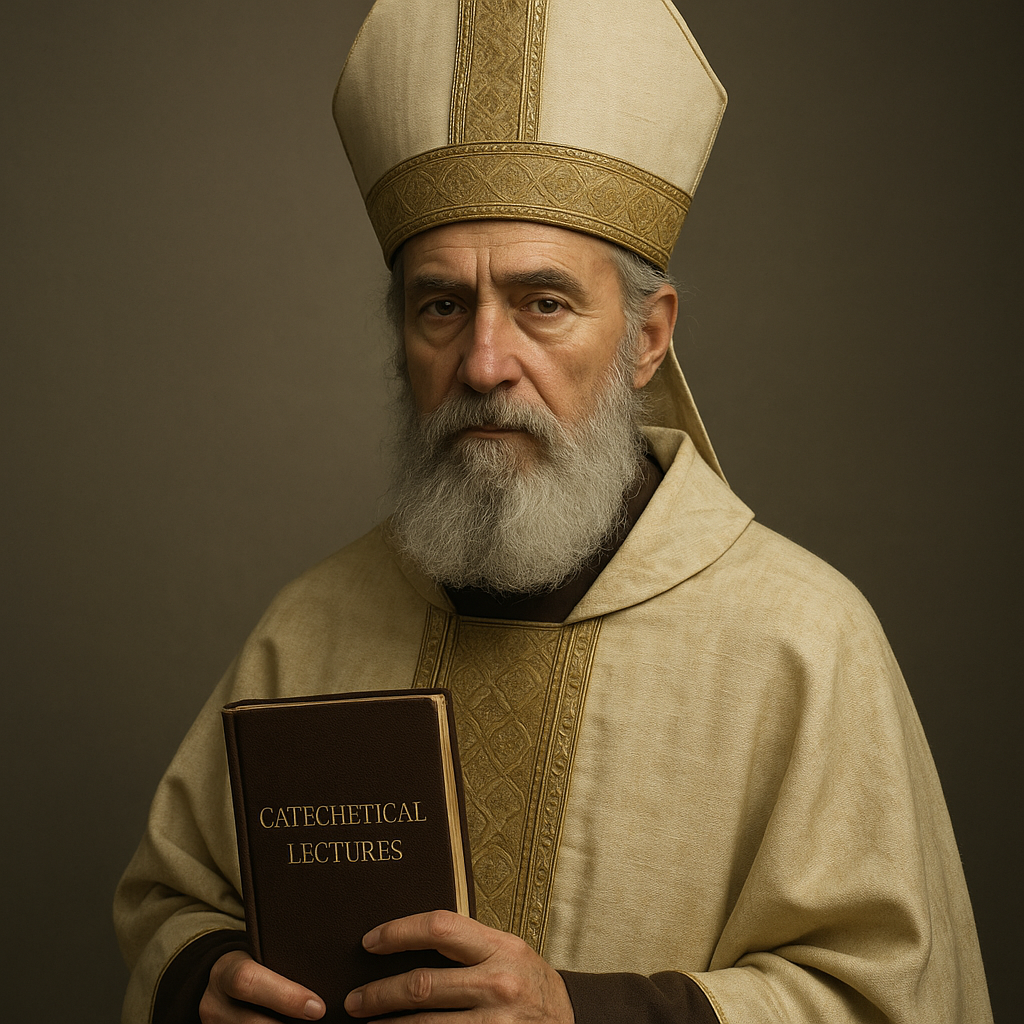
In the vibrant, often turbulent world of the early Church, a towering figure emerged from the ancient city of Jerusalem: St. Cyril. This remarkable saint, a bishop and Doctor of the Church, dedicated his life to teaching the Christian faith with clarity and courage, even in the face of intense opposition and exile. His famous “Catechetical Lectures” remain a timeless treasure, guiding new believers through the mysteries of the Creed, Baptism, and the Eucharist, making profound theological truths understandable and deeply personal. Join us as we explore the life, struggles, and enduring spiritual wisdom of St. Cyril of Jerusalem, a man whose steadfast faith continues to inspire and instruct the Church today.
Quick Facts
| Category | Detail |
|---|---|
| Birth | c. 313 AD, likely in or near Jerusalem |
| Death | c. 386 AD, Jerusalem |
| Feast Day | March 18 (Western Church); May 7 (Eastern Church) |
| Patronage | Catechists, teachers of the faith, Jerusalem |
| Canonized | Pre-Congregation (recognized as a saint since ancient times); Declared a Doctor of the Church in 1883 by Pope Leo XIII |
Historical Context & Early Life
St. Cyril of Jerusalem lived during a pivotal and often tumultuous period in Church history, the 4th century. The Roman Empire, which had long persecuted Christians, had recently shifted its stance. Emperor Constantine’s Edict of Milan in 313 AD granted religious toleration, and Christianity began its ascent as the dominant religion. However, this newfound freedom brought its own challenges, especially internal theological disputes that threatened to tear the Church apart. The most significant of these was Arianism, a heresy that denied the full divinity of Jesus Christ, claiming He was a created being rather than fully God, co-eternal with the Father. This debate raged across the empire, influencing emperors, bishops, and everyday believers.
Geopolitically, Jerusalem itself held immense significance. As the city where Jesus lived, died, and rose again, it was a burgeoning center for Christian pilgrimage and a symbolic heartland of the faith. The city was under Roman rule, but its Christian identity was rapidly growing. Grand churches, like the Church of the Holy Sepulchre, were being constructed, transforming the city’s landscape and reinforcing its spiritual importance. This was the world into which Cyril was born, likely around 313 AD, in or near Jerusalem. We know little about his family background, but it’s clear he received an excellent education, immersing himself in both classical learning and, crucially, the Scriptures and the teachings of the early Church Fathers. This rigorous intellectual and spiritual formation would prepare him for the immense responsibilities he would later bear.
Calling & Key Milestones
Ordination and Early Ministry
Cyril was ordained a deacon by Macarius, Bishop of Jerusalem, and later a priest by Maximus, Macarius’s successor. His early ministry was characterized by his dedication to teaching. He quickly gained a reputation for his deep understanding of Scripture and his ability to explain complex theological concepts in an accessible way. This gift for clear communication would become the hallmark of his life’s work. During this time, the Church in Jerusalem was actively engaged in preparing new converts for baptism, a process known as catechesis. Cyril’s role in this vital ministry laid the groundwork for his future contributions.
Bishop of Jerusalem and the Catechetical Lectures
Around 350 AD, Cyril was appointed Bishop of Jerusalem, a position of great spiritual authority and political challenge. It was during his episcopate, likely in the early years, that he delivered his most enduring legacy: the “Catechetical Lectures.” These twenty-four lectures, delivered to catechumens (those preparing for Baptism) and the newly baptized (the “mystagogical lectures”), provide a comprehensive overview of Christian doctrine and practice. They cover everything from the Creed and the meaning of sin and repentance to the Sacraments of Baptism, Confirmation, and the Eucharist. Cyril’s lectures are remarkable for their pastoral warmth, their grounding in Scripture, and their direct witness to the practices of the early Church in Jerusalem. He unveiled the mysteries of the faith not as abstract theories but as living realities for the believer.
Struggle Against Arianism and Exiles
Cyril’s episcopate was marked by intense theological controversy, specifically the ongoing Arian heresy. Unlike many Arian sympathizers who held positions of power, Cyril remained staunchly orthodox, upholding the Council of Nicaea’s teaching that Jesus is truly God, “of one substance with the Father.” This unwavering fidelity to truth led to immense suffering. He was exiled from his see (his bishopric) at least three times, a common fate for orthodox bishops during this era when Arian emperors and influential bishops sought to impose their views. These exiles were not short trips but periods of years spent away from his flock, often in difficult circumstances. His first exile was due to accusations by Acacius, the powerful Arian Bishop of Caesarea, with whom Cyril had long-standing disputes, including over the hierarchical status of their respective sees. His subsequent exiles were also tied to the shifting political and theological landscape, as various emperors supported or opposed Arianism.
The Council of Constantinople
Despite his suffering and repeated exiles, Cyril eventually returned to Jerusalem, welcomed back by his people. His steadfastness was finally recognized. In 381 AD, he participated in the First Council of Constantinople, a momentous gathering that reaffirmed the Nicene Creed and clarified the doctrine of the Holy Spirit. Cyril played a significant role in this council, a testament to his enduring orthodox faith and his reputation as a defender of the truth. His presence at this council, years after his initial struggles, represents a powerful vindication of his commitment to sound doctrine.
Spiritual Legacy & Theological Themes
St. Cyril of Jerusalem’s spiritual legacy is profound and multifaceted, deeply influencing how the Church understands and teaches the faith. He exemplified several core virtues: unwavering fidelity to orthodox doctrine, exceptional pastoral care, and remarkable courage in the face of persecution. His life demonstrates the importance of standing firm in truth, even when it comes at a great personal cost.
His theological themes are most clearly articulated in his Catechetical Lectures. Central to his teaching is the emphasis on the Sacraments as tangible encounters with God’s grace. He speaks powerfully about Baptism as a death to sin and a rebirth in Christ, Confirmation as an anointing with the Holy Spirit that empowers believers, and especially the Eucharist. For Cyril, the Eucharist is not merely a symbol but the true Body and Blood of Christ, received for the nourishment of the soul. He taught the faithful to approach the altar with reverence, understanding that they were receiving the Lord Himself. This aligns perfectly with Catholic teaching on the Real Presence of Christ in the Eucharist, as expressed in Scripture in passages like John 6:53-56, where Jesus says, “Unless you eat the flesh of the Son of Man and drink his blood, you have no life in you.”
Cyril also underscored the importance of the Nicene Creed as a summary of the faith, guiding catechumens through each article with meticulous care. He emphasized the role of the Holy Spirit in Christian life, guiding believers into all truth and empowering them to live holy lives. His stress on sound doctrine, rooted in Scripture and apostolic tradition, served as a crucial bulwark against the Arian heresy. He didn’t just tell people what to believe; he explained why, encouraging a deep, personal understanding and assent to the faith.
His lasting influence on liturgy and catechesis is immense. The structure of his Catechetical Lectures continues to inspire modern catechetical programs, providing a model for instructing new converts. His detailed descriptions of the Baptismal rites and Eucharistic liturgy in 4th-century Jerusalem offer invaluable insights into early Christian worship, helping us appreciate the continuity of Catholic tradition. He is rightly honored as a Doctor of the Church for his extraordinary contributions to theological understanding and pastoral formation.
Devotion Today
St. Cyril of Jerusalem remains a revered figure in both the Eastern and Western Churches. While there may not be grand shrines solely dedicated to him in the same way as some other saints, his spiritual presence is deeply felt, particularly in the holy city of Jerusalem. As a former Bishop of Jerusalem, he is intrinsically linked to the sacred sites where he lived, taught, and suffered for the faith. Pilgrims visiting Jerusalem are walking in the footsteps of St. Cyril, connecting with the very ground where he catechized new Christians and celebrated the sacraments.
His feast day is celebrated on March 18th in the Western Church and May 7th in the Eastern Church, where his memory is honored in liturgical services. Beyond specific geographical devotion, his most significant living memorial is his writings, especially the “Catechetical Lectures.” These texts are still studied by seminarians, theologians, and anyone seeking a deeper understanding of early Christian doctrine and practice. Many catechists and religious educators turn to St. Cyril for inspiration, seeing him as a patron and model for their own work of transmitting the faith. His clear, systematic approach to teaching the Creed and the Sacraments continues to make him an important guide for contemporary catechesis, reminding us of the enduring power of foundational Christian truths.
Reflections for Modern Readers
St. Cyril of Jerusalem, though he lived centuries ago, offers timeless wisdom and practical lessons for us today. His life and teachings provide profound insights for navigating our own spiritual journeys.
- Stand Firm in the Truth: Cyril faced intense pressure and exile because he refused to compromise on the truth of Christ’s divinity. In a world full of shifting opinions and relativistic thinking, his life reminds us to root our faith in the unchanging truths revealed by God and taught by the Church. For example, when faced with popular opinions that contradict Church teaching on ethical issues, St. Cyril encourages us to research, understand the Church’s position, and defend it chararly, just as he defended the divinity of Christ.
- Value Catechesis and Learning Your Faith: His “Catechetical Lectures” weren’t just for new converts; they were foundational. St. Cyril teaches us that a deep, intellectual, and spiritual understanding of our faith is essential. This means actively engaging with Scripture, Church teaching, and theology throughout our lives. For example, instead of just attending Mass, we can delve into the meaning of the liturgy, study the Creed, or read about the lives of saints. His work encourages us to be lifelong learners in faith, always seeking to understand God more fully.
- Reverence for the Sacraments: Cyril’s mystagogical lectures beautifully unveil the profound reality of Baptism, Confirmation, and especially the Eucharist. He calls us to approach these sacred rites with awe and deep gratitude, recognizing them as true encounters with Christ’s grace. In our fast-paced world, it’s easy to take the Sacraments for granted. St. Cyril reminds us to slow down, prepare our hearts, and truly appreciate the immense gifts God offers us through them, such as truly engaging in the Mass rather than simply “going through the motions.”
- Perseverance in the Face of Adversity: St. Cyril’s repeated exiles highlight his remarkable perseverance. He endured hardship and separation from his flock, yet he never abandoned his faith or his call. When we face challenges in our lives—whether personal struggles, professional setbacks, or spiritual dryness—St. Cyril is a powerful example of enduring with hope and trusting in God’s providence, knowing that even in exile, God is with us.
In art and jewelry, St. Cyril of Jerusalem is most commonly depicted in the attire of a bishop: a miter (the pointed hat), a crosier (pastoral staff), and often holding a book or a scroll. The miter and crosier symbolize his authority and role as a shepherd of the Church, guiding and protecting his flock. The book or scroll represents his profound learning and, more specifically, his invaluable “Catechetical Lectures,” which are his lasting theological contribution. Sometimes, he might be shown with a dove, symbolizing the Holy Spirit, whose role in the Sacraments and in guiding the Church he so eloquently explained. These symbols remind us of his identity as a wise teacher, a courageous bishop, and a faithful defender of the Catholic faith.
Timeline Summary
- c. 313 AD: Born in or near Jerusalem.
- Early 340s: Ordained a deacon, then a priest, serving under Bishop Maximus of Jerusalem.
- c. 350 AD: Appointed Bishop of Jerusalem, succeeding Maximus.
- c. 350–351 AD: Delivers his famous “Catechetical Lectures” to catechumens and the newly baptized.
- 357 AD: First exile from Jerusalem due to accusations by Acacius of Caesarea, an influential Arian bishop.
- 360 AD: Second exile by Emperor Constantius II, who favored Arianism.
- 362 AD: Returns to Jerusalem under Emperor Julian, who recalled all exiled bishops.
- 367 AD: Third exile by Emperor Valens, another Arian sympathizer.
- 378 AD: Returns permanently to Jerusalem after the death of Emperor Valens and the ascent of Emperor Theodosius I, who supported Nicene orthodoxy.
- 381 AD: Attends the First Council of Constantinople, which reaffirms the Nicene Creed and clarifies the doctrine of the Holy Spirit.
- c. 386 AD: Dies peacefully in Jerusalem.
- 1883: Declared a Doctor of the Church by Pope Leo XIII.
Scripture for Reflection
St. Cyril’s life and teachings resonate deeply with several passages from Scripture, particularly those emphasizing the importance of teaching, perseverance in faith, and the reality of the Sacraments.
1. On the Importance of Teaching and Sound Doctrine:
“All Scripture is God-breathed and is useful for teaching, rebuking, correcting and training in righteousness, so that the servant of God may be thoroughly equipped for every good work.” (2 Timothy 3:16-17)
St. Cyril dedicated his life to teaching the truth of Scripture and defending sound doctrine against error. His Catechetical Lectures are a testament to the power of thorough instruction in preparing believers for a life of faith. He believed, like St. Paul, that faithful teaching equips us for all good works and helps us grow in righteousness.
2. On Perseverance in Faith During Persecution:
“Blessed are those who are persecuted for righteousness’ sake, for theirs is the kingdom of heaven. Blessed are you when others revile you and persecute you and utter all kinds of evil against you falsely on my account. Rejoice and be glad, for your reward is great in heaven, for so they persecuted the prophets who were before you.” (Matthew 5:10-12)
Cyril endured multiple exiles and immense pressure for upholding the orthodox faith. This passage from Jesus’ Sermon on the Mount speaks directly to his experience, reminding us that suffering for the sake of Christ’s truth is a blessed path, leading to a great reward. His perseverance inspires us to remain steadfast when our faith is challenged.
3. On the Reality of the Eucharist:
“Whoever eats my flesh and drinks my blood has eternal life, and I will raise him up on the last day. For my flesh is true food, and my blood is true drink. Whoever eats my flesh and drinks my blood remains in me, and I in him.” (John 6:54-56)
St. Cyril’s “mystagogical catechesis” profoundly explained the Real Presence of Christ in the Eucharist, preparing the newly baptized to receive this most sacred Sacrament with reverence and understanding. This passage from John’s Gospel confirms the literal truth of Jesus’ words, which Cyril so faithfully taught, emphasizing the life-giving union with Christ that occurs through Eucharistic communion.
Prayers to St. Cyril of Jerusalem
While there isn’t one universally known, official novena specifically to St. Cyril, we can offer prayers that reflect his legacy as a teacher and defender of the faith. Here is a prayer inspired by his life and work:
A Prayer to St. Cyril of Jerusalem
O glorious St. Cyril of Jerusalem, holy Bishop and Doctor of the Church, you dedicated your life to enlightening souls with the truths of our Catholic faith. With unwavering courage, you defended the divinity of Christ against heresy and patiently instructed catechumens in the mysteries of Baptism, Confirmation, and the Most Holy Eucharist. We implore your intercession, that we may, like you, grow in a deeper understanding and love for the sacred Sacraments and the Creed.
Grant us the grace to stand firm in our faith, especially when faced with doubt or opposition. Inspire all catechists and teachers of the faith to imitate your clarity, pastoral warmth, and steadfastness in proclaiming the Gospel. May your example lead us to reverence the Holy Eucharist as the true Body and Blood of our Lord, and to live lives worthy of the Christian calling.
St. Cyril, pray for us, that we may always seek truth, live virtuously, and persevere in our journey towards eternal life with Christ, our Lord. Amen.
For Guidance in Catechesis:
St. Cyril of Jerusalem, Patron of Catechists, you were a diligent and clear teacher of the faith. Look favorably upon all who strive to pass on the Deposit of Faith to new generations. Guide them in their words and actions, that they may effectively communicate the beauty and truth of Christ’s teachings. Help them to foster a living relationship with Jesus in the hearts of those they teach, just as you did in ancient Jerusalem. Amen.





