
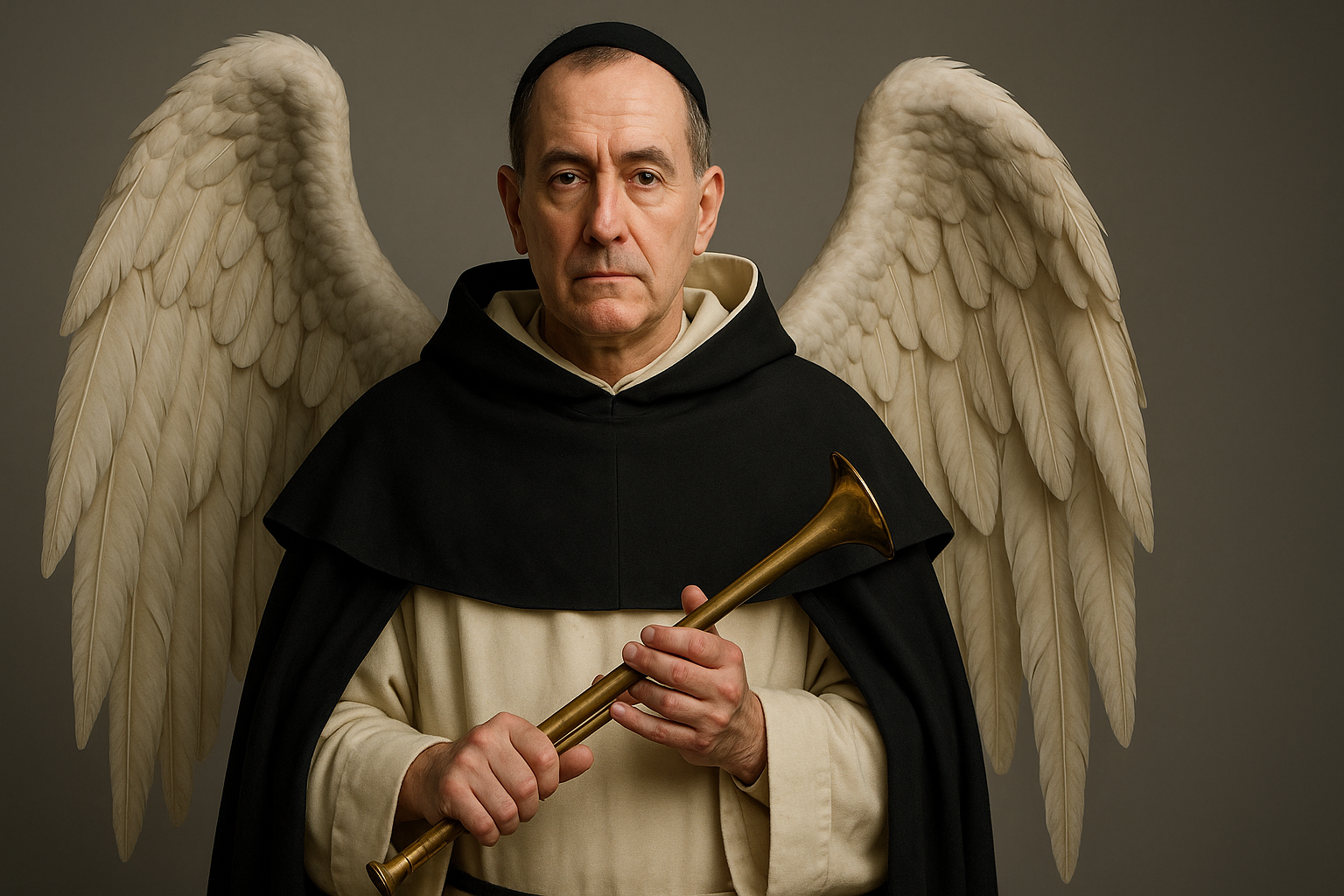
In the vast tapestry of Catholic saints, few figures stand out with the dramatic flair and zealous fervor of St. Vincent Ferrer. Born into a world wracked by plague, war, and the profound crisis of the Great Western Schism, Vincent Ferrer emerged as a beacon of hope and a trumpet call for repentance. His life was a whirlwind of tireless preaching, miraculous signs, and unwavering dedication to the Gospel, earning him the title “Angel of the Apocalypse” not for doom, but for his urgent message of God’s mercy and the call to prepare for His kingdom. This article will explore his early life and the tumultuous era he navigated, delve into his extraordinary vocation as a traveling preacher, uncover his profound spiritual legacy, and examine how his enduring message continues to resonate with believers in the modern world.
Quick Facts
| Category | Detail |
|---|---|
| Birth | January 23, 1350, Valencia, Kingdom of Valencia (Crown of Aragon) |
| Death | April 5, 1419, Vannes, Brittany (France) |
| Feast Day | April 5 |
| Patronage | Builders, construction workers, plumbers, fishermen, Valencia, Brittany, false accusations, difficult marriages, headaches, orphaned children, preachers. |
| Canonized | June 3, 1455, by Pope Callixtus III |
Historical Context & Early Life
To understand St. Vincent Ferrer, one must first grasp the turbulent backdrop against which his life unfolded. The 14th century was a period of immense upheaval in Europe, profoundly shaped by several cataclysmic events. The Black Death, which swept across the continent in the mid-1300s, decimated populations, shattered social structures, and instilled a pervasive sense of dread and a preoccupation with death and judgment. This era also saw the continuation of the Hundred Years’ War, a brutal and protracted conflict that further destabilized kingdoms and led to widespread suffering.
Perhaps most significantly for the Church, Vincent Ferrer lived through the Great Western Schism (1378-1417), a crisis of unprecedented proportions that saw two, and at one point even three, rival claimants to the papacy. Each pope had his own college of cardinals, administrative apparatus, and political alliances, leading to widespread confusion, division, and a deep erosion of faith and trust in the Church’s leadership. This division was not merely theoretical; it split families, kingdoms, and religious orders, creating a profound spiritual vacuum and an urgent need for reform and clarity.
It was into this volatile world that Vincent Ferrer was born on January 23, 1350, in Valencia, a vibrant and prosperous city in the Kingdom of Aragon (modern-day Spain). His family was noble and deeply pious. His father, William Ferrer, was a notary, and his mother, Constance Miguel, was known for her virtue. From an early age, Vincent displayed exceptional intelligence, a sharp wit, and a profound devotion to God. He quickly mastered his studies, excelling in rhetoric, logic, and theology. Even as a young boy, he was known for his humility and charity, often distributing food and alms to the poor from his family’s household.
At the age of 17, against the initial wishes of his parents who hoped he might pursue a more worldly career, Vincent Ferrer made the decisive choice to enter the Order of Preachers, the Dominicans. This decision marked the beginning of his lifelong commitment to God and to the mission of spreading the Gospel. His time in the monastery was characterized by rigorous study, intense prayer, and strict ascetical practices. He quickly distinguished himself as a brilliant scholar, mastering philosophy and theology, and was eventually ordained a priest. His intellectual prowess and deep spiritual life prepared him for the extraordinary ministry that lay ahead.
Calling & Key Milestones
A Prophetic Vocation
Vincent Ferrer’s initial years as a Dominican friar were dedicated to scholarship and teaching. He became a respected professor of theology at the University of Valencia and served as an advisor to several influential figures, including Cardinal Pedro de Luna, who would later become Pope Benedict XIII during the Western Schism. However, his life took a dramatic turn in 1398. While gravely ill, Vincent experienced a powerful vision. He recounted seeing Christ alongside Saints Peter and Paul, who appeared to him and commissioned him to preach penance throughout the world. This profound spiritual encounter was not just a recovery from illness; it was a divine mandate that irrevocably altered the course of his life. From that moment on, his focus shifted entirely from scholarly pursuits to that of an itinerant, evangelical preacher, embodying the Dominican charism of preaching for the salvation of souls.
The Voice of Repentance and Reform
Empowered by his vision, St. Vincent Ferrer embarked on an extraordinary twenty-year mission of evangelization that spanned much of Western Europe. He traveled on foot, often accompanied by a large company of followers, including fellow Dominicans, penitents, and even flagellants, a common practice of public penance at the time. His preaching was legendary. He possessed an incredible oratorical gift, capable of captivating massive crowds numbering in the tens of thousands. Though he usually preached in his native Valencian or Latin, he was widely believed to be endowed with the “gift of tongues,” meaning people from different linguistic backgrounds could understand his message. His sermons were vivid, dramatic, and imbued with an urgent call to repentance, drawing heavily on themes of sin, divine judgment, the coming of the Antichrist, and the glory of the Last Judgment.
Yet, despite the formidable warnings, his ultimate message was one of hope and God’s boundless mercy. He called for a sincere change of heart, confession of sins, and a return to Christ. He moved through France, Spain, Portugal, Italy, Switzerland, and even ventured to England, Scotland, and Ireland, leaving a trail of converted hearts and renewed spiritual fervor in his wake. His preaching ignited spiritual revivals wherever he went, leading many to confess their sins, make peace with their neighbors, and deepen their commitment to Christ.
Miracles and Conversions
St. Vincent Ferrer’s ministry was accompanied by an astonishing array of miracles, which further amplified his reputation and drew even larger crowds. Countless reports attested to his power to heal the sick, restore sight to the blind, and even raise the dead. These miracles were not mere spectacles; they were seen as divine confirmations of his prophetic mission and the urgency of his message. His presence was so powerful that many simply sought to touch his habit or hear his voice, believing in his spiritual authority.
Beyond physical healings, his greatest miracles were often considered the spiritual conversions he inspired. He was particularly successful in converting large numbers of Jews and Muslims, who, after hearing his sermons and witnessing the fervent faith of his followers, chose to embrace Christianity. While the historical context of such mass conversions can be complex, the personal testimonies from his time speak of genuine spiritual awakenings and profound transformations of life, emphasizing his skill as a reconciler and a bringer of spiritual healing in a deeply divided society.
Role in the Western Schism
For many years, St. Vincent Ferrer found himself in a difficult position regarding the Western Schism. As a respected theologian and friend, he initially supported Cardinal Pedro de Luna, who became Pope Benedict XIII in Avignon. Vincent served as his confessor and advisor, genuinely believing in Benedict’s legitimacy. However, as the schism dragged on, causing immense scandal and division within the Church, Vincent became increasingly disillusioned with Benedict XIII’s refusal to resign for the sake of unity. In a decisive moment in 1416, St. Vincent courageously publically withdrew his allegiance from Benedict XIII during an assembly in Perpignan. This powerful act, coming from such a renowned and holy figure, had an enormous impact. It swayed many secular rulers, including the King of Aragon, and other ecclesiastical leaders to also withdraw their support from Benedict XIII, effectively isolating him and paving the way for the Council of Constance to resolve the schism and elect a single, universally recognized Pope Martin V in 1417. His decision, born of deep spiritual conviction and a profound love for Church unity, solidified his legacy not just as a preacher, but as a crucial peacemaker and reformer.
The Art of Preaching
St. Vincent Ferrer’s impact on homiletics, the art of preaching, was immense. His sermons were not abstract theological treatises but direct, practical, and emotionally charged calls to action. He used simple, accessible language, vivid metaphors, and dramatic gestures to connect with his audience. He often structured his sermons around the “three temptations” (the world, the flesh, and the devil) and urged listeners to examine their consciences, seek forgiveness through the Sacrament of Confession, and live lives of virtue. His method of preaching was so effective that it became a model for later evangelists. He emphasized that preaching must be an encounter, a transformative experience that moves the heart as well as the mind, always directed towards the ultimate goal of salvation.
Spiritual Legacy & Theological Themes
St. Vincent Ferrer’s spiritual legacy is primarily rooted in the core virtues he exemplified and tirelessly preached. At the heart of his message was the urgent call to penance and repentance. In a time of widespread moral decay and spiritual confusion, Vincent relentlessly reminded people of their sins and the necessity of turning back to God. This wasn’t a message of despair, but one imbued with hope, emphasizing that God’s mercy is always available to those who sincerely seek it. He taught that true repentance involved not just sorrow for sin, but also a firm purpose of amendment and a commitment to living a virtuous life, often recommending practices of fasting, prayer, and almsgiving.
Closely linked to repentance was his profound witness to humility. Despite his immense fame, the crowds that followed him, and the powerful miracles attributed to him, Vincent Ferrer remained a simple Dominican friar. He famously refused a cardinal’s hat and other ecclesiastical honors, preferring to remain a humble servant of God, focused solely on his mission. This radical humility made his message all the more credible and compelling.
His ministry was also a testament to boundless charity. He not only preached compassion but actively lived it, caring for the poor, the sick, and the marginalized. He saw in every person, regardless of their station or spiritual state, a soul in need of God’s love. This universal charity fueled his tireless zeal for souls, driving him across continents to preach the Gospel and draw people closer to Christ.
These virtues align perfectly with Scripture and Catholic teaching. His call to repentance echoes the very first public words of Jesus in the Gospel of Mark: “Repent, and believe in the gospel” (Mark 1:15). His emphasis on God’s mercy and forgiveness finds resonance in countless passages, reminding us that “The Lord is gracious and compassionate, slow to anger and rich in love” (Psalm 145:8). His life of humility and service exemplifies Christ’s teaching that “whoever wants to become great among you must be your servant” (Matthew 20:26). Vincent Ferrer’s preaching underscored the vital importance of the Sacraments, especially Confession, as pathways to God’s grace and healing, a cornerstone of Catholic belief.
His lasting influence extends beyond his immediate impact. He left an indelible mark on the tradition of Catholic preaching, inspiring generations of evangelists to deliver the Gospel with clarity, passion, and spiritual urgency. While he was not a prolific writer of theological treatises, his sermons, though often transcribed by others, shaped popular understanding of sin, judgment, and redemption. He demonstrated that rigorous intellectual formation, combined with fervent prayer and a deep spiritual life, could produce a powerful and transformative ministry. His dedication to Church unity during the Schism also serves as a timeless example of how spiritual leaders can act as instruments of peace and reconciliation.
Devotion Today
Even centuries after his death, devotion to St. Vincent Ferrer remains vibrant, particularly in the regions where he preached so extensively. His primary shrine and tomb are located in Vannes, Brittany, France, where he died. This site draws pilgrims and visitors who come to honor his memory and seek his intercession. In his birthplace of Valencia, Spain, he is revered as a patron saint, and his feast day on April 5th is celebrated with great solemnity and civic pride. The city hosts elaborate processions, special Masses, and cultural events that commemorate his life and ministry.
Numerous churches, chapels, and confraternities around the world bear his name, reflecting the enduring admiration for his holiness and his powerful intercession. He is a particularly beloved figure among the Dominican Order, who cherish him as one of their most illustrious members and a model of zealous preaching. His patronage extends to builders, construction workers, and plumbers, perhaps reflecting the idea of “building up” the Church and society, or perhaps due to popular legends associated with him.
Families in difficult marriages and those facing false accusations also turn to him, recognizing his role as a peacemaker and a defender of truth. Though his dramatic warnings of judgment might seem intense to modern ears, his message of divine mercy and the imperative of personal conversion continues to inspire believers to live more faithfully and prepare their hearts for God’s presence.
Reflections for Modern Readers
St. Vincent Ferrer’s life, though lived in a vastly different era, offers profound and actionable takeaways for 21st-century Catholics seeking to navigate a complex world:
- Embrace the Call to Repentance: In an age of comfort and self-justification, Vincent’s call to repentance reminds us of the constant need for moral self-reflection and a turning back to God. This isn’t about guilt, but about growth. For modern readers, this might mean regularly examining our digital habits, our consumer choices, or our relationships to see where we might be drifting from Christian values, and making concrete steps to realign with God’s will.
- Cultivate Courageous Evangelization: Vincent preached with unyielding passion in a fractured society. Today, many feel hesitant to share their faith. His example encourages us to speak the truth with love, whether through a compassionate conversation, a thoughtful online post, or simply by living an authentically Christian life that witnesses to God’s presence.
- Live with Urgency and Purpose: Vincent believed the end times were near, which fueled his tireless ministry. While we may not share his exact eschatological outlook, his zeal reminds us that life is fleeting. This takeaway prompts us to prioritize what truly matters – our relationship with God, our families, and service to others – over endless distractions and superficial pursuits.
- Be a Peacemaker and Unifier: His critical role in ending the Western Schism highlights the power of spiritual conviction to heal profound divisions. In a world often polarized by politics, culture, and even within the Church, St. Vincent Ferrer challenges us to seek common ground, foster dialogue, and work tirelessly for unity and understanding, beginning in our own communities and families.
- Keep the Message Simple and Heartfelt: Vincent’s preaching was powerful because it was clear, direct, and touched the heart. Modern communication often overcomplicates. His approach reminds us that the core Gospel message – God’s love, the reality of sin, and the path to salvation through Christ – is profound enough when delivered simply and sincerely.
In art and jewelry, St. Vincent Ferrer is often depicted with specific symbols that reflect his life and message. He is frequently shown with wings, symbolizing his title “Angel of the Apocalypse” or “Angel of Judgment,” indicating his role as a herald of divine truth and the Last Judgment. He is often depicted in a Dominican habit, preaching with a raised hand or pointing upwards, signifying his oratorical power and his focus on heavenly realities. You might see a trumpet near him, announcing the urgent call to repentance, or a book or scroll, representing the Holy Scriptures from which he preached. Sometimes, a cardinal’s hat lies at his feet, a visual reminder of his humble refusal of ecclesiastical honors. Flames or fire can also be present, alluding to the fiery passion of his sermons and the purifying nature of divine judgment. A skull or images related to the Last Judgment are also common, reflecting the eschatological themes central to his preaching. These symbols serve not only as identifiers but also as visual summaries of his profound spiritual message.
Timeline Summary
- 1350: Born in Valencia, Kingdom of Valencia (Crown of Aragon).
- 1367: Entered the Dominican Order at the age of 17.
- 1370s: Ordained a priest and began teaching philosophy and theology at the University of Valencia.
- 1378: The Great Western Schism begins, dividing the papacy. Vincent initially supports the Avignon papacy.
- 1398: Experiences a profound vision during a serious illness, commissioning him to preach penance throughout the world.
- 1399-1419: Embarks on an extensive twenty-year itinerant preaching ministry across Europe, known for its powerful conversions and miracles.
- 1416: Publicly withdraws allegiance from Pope Benedict XIII (Avignon Pope), a pivotal act that helped resolve the Western Schism.
- 1417: The Council of Constance successfully ends the Western Schism with the election of Pope Martin V.
- 1419: Dies on April 5 in Vannes, Brittany (France).
- 1455: Canonized by Pope Callixtus III on June 3.
Scripture for Reflection
St. Vincent Ferrer’s life and ministry beautifully illuminate several passages from Scripture, particularly those related to repentance and the urgent call of the Gospel.
Mark 1:15: “The time has come,” he said. “The kingdom of God has come near. Repent and believe the good news!”
This verse perfectly encapsulates the core of St. Vincent’s message. Like John the Baptist and Jesus Himself, Vincent Ferrer urged his listeners to recognize the arrival of God’s reign and to respond with a change of heart and a firm belief in the Gospel. His preaching wasn’t just about foretelling judgment; it was about preparing souls for the Kingdom of God through repentance.
James 5:20: “whoever turns a sinner from the error of their way will save them from death and cover over a multitude of sins.”
This passage speaks directly to St. Vincent’s tireless zeal for converting souls. He dedicated his life to turning people away from sin and towards God, understanding that this spiritual transformation leads to eternal life. His miraculous conversions and the profound impact of his preaching truly exemplified this scriptural truth, as he worked to save countless souls from spiritual death and lead them to God’s mercy.
Prayers to St. Vincent Ferrer
O glorious Saint Vincent Ferrer, admirable model of penance and mortification, the Angel of Judgment who converted so many sinners, hear our prayers. Obtain for us, we beseech you, from God, our Heavenly Father, a sincere sorrow for our sins, a lively faith, a firm hope, and a burning charity. Help us to persevere in good works to the end of our lives, and to merit the everlasting rewards of heaven. May your example inspire us to proclaim the Gospel with courage and charity, and to work for the unity of the Church. Through your powerful intercession, may we be granted the grace to overcome temptation, grow in virtue, and attain eternal salvation. Amen.





