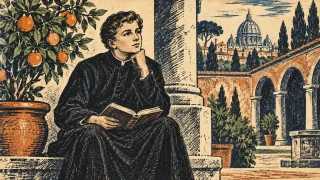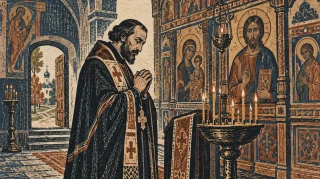

Prayer can become anxious when we spend more time judging our performance than turning toward God. St. Gertrude the Great, a medieval nun and spiritual writer, offers a different focus: confidence in divine love, nourished by Scripture and the prayer of the Church.
Gertrude of Helfta
Gertrude was born in 1256 and grew up in the religious community at Helfta. She received a substantial education and later described a deepening spiritual life centered on Christ. Her writings connect personal prayer with Scripture and the liturgy. She is distinct from Gertrude of Hackeborn, the abbess at Helfta. Gertrude the Great’s liturgical feast is November 16. Benedict XVI explains her life and spiritual teaching.
Let a familiar prayer slow you down
Choose a prayer you already know, such as the Our Father. Say it slowly enough to notice one phrase. Pause there. What does it invite you to ask, receive, or change? Continue when you are ready, without feeling obliged to produce a profound insight.
Another option is to revisit a short passage from Sunday’s readings. Read it aloud if that helps. A familiar text can sound different when you stop treating familiarity as a reason to hurry.
Trust does not require a particular feeling
A peaceful moment can be a gift. So can the decision to pray when you do not feel peaceful. Try not to make a daily emotional result the test of whether prayer is worth continuing.
For a week, choose a brief and steady practice. At the end, ask whether you have made room for God and whether that attention is shaping your treatment of others. Those questions may be more useful than rating each session as good or bad.
Be careful with prayers circulated online
A prayer image may attach a saint’s name to a promise without explaining its source. Before repeating a precise claim about guaranteed spiritual results, look for a reliable explanation. If you cannot verify an attribution, you can still pray sincerely while describing the words honestly as a devotional text of uncertain origin.
For family use, a short original prayer may be enough: “God of mercy, help us trust your love and show that love to someone today.” These suggested words are not a quotation from Gertrude.
A practice for the coming Sunday
- Read one of the Mass readings before leaving home.
- Listen for a phrase that stays with you during the liturgy.
- Recall it once during the week, perhaps at the start of the day.
- Connect it with one concrete act of patience, gratitude, or service.
Gertrude’s story invites a relationship between the Church’s public prayer and the quiet life of the heart. For another introduction to trust in Christ’s love, read our Sacred Heart feature on St. Margaret Mary Alacoque.