In the rolling hills of Umbria, where the medieval town of Assisi rises majestically, two great lights ignited the spiritual landscape of the 13th century. While Saint Francis of Assisi is often celebrated for his radical embrace of poverty and his profound love for creation, his spiritual sister, Saint Clare, played an equally pivotal role in shaping Christian spirituality. Born into nobility, Clare boldly renounced a life of comfort to pursue an even more radical path of evangelical poverty, founding the Order of Poor Ladies, now known as the Poor Clares. Her life is a testament to unwavering faith, contemplative prayer, and a fierce devotion to Christ, offering timeless lessons on trust, simplicity, and spiritual courage. This article will explore her journey, her lasting legacy, and how her spirit continues to inspire believers today.
Quick Facts
| Category | Detail |
|---|---|
| Birth | July 16, 1194, Assisi, Italy |
| Death | August 11, 1253, Assisi, Italy |
| Feast Day | August 11 |
| Patronage | Television, eye disease, embroiderers, gold workers, laundry, good weather, needleworkers, Santa Clara (California) |
| Canonized | August 15, 1255, by Pope Alexander IV |
Historical Context & Early Life
The early 13th century in central Italy was a time of dynamic change, marked by political unrest, burgeoning trade, and a powerful spiritual awakening. Assisi, a hilltop town in Umbria, was no stranger to the era’s complexities. It was a place where feudal structures were slowly giving way to communal governance, and the wealth disparity between the noble class and the common people was increasingly evident. Into this world, on July 16, 1194, was born Chiara Offreduccio, later known as Clare. She was the eldest daughter of Favarone Offreduccio, a wealthy count, and Ortolana, a devout woman from a noble family. Her upbringing was typical for an aristocratic young woman of her time: shielded, educated, and expected to make an advantageous marriage.
Despite her privileged background, young Clare showed an early inclination toward piety and compassion. She spent her youth in prayer and acts of charity, secretly setting aside food from her family’s table for the poor. Her mother, Ortolana, a woman of deep faith who had made pilgrimages to Rome and the Holy Land, likely fostered this spiritual sensitivity. The seeds of a life dedicated to God were sown not in the grand halls of a monastery but in the quiet corners of her family home, where Clare’s heart yearned for something more profound than worldly possessions or social status.
This was also the era of the Crusades and the rise of mendicant orders – religious groups who lived by begging and renounced all property, embracing a life of extreme poverty. The most notable among these nascent movements was that of Francis Bernardone, a charismatic young man from Assisi who, after a dramatic conversion, began preaching a radical Gospel message of poverty, peace, and love. His impassioned sermons and simple way of life quickly captivated the hearts of many, including the young noblewoman, Clare, who would soon become his most devoted spiritual daughter.
Calling & Key Milestones
A Radical Encounter and Vow of Poverty
Clare’s life took an irreversible turn when she heard Francis preach during the Lenten season of 1211 (or 1212). His words, calling for a complete renunciation of worldly goods and a total surrender to Christ, resonated deeply with her soul. She saw in Francis’s way of life the authentic Gospel she had always yearned for. Despite her family’s plans for her marriage and the social expectations of her class, Clare secretly sought spiritual guidance from Francis. He recognized in her a spirit kindred to his own, a soul ready for radical discipleship.
On the night of Palm Sunday, March 18, 1212, Clare, then 18 years old, slipped away from her family home. She met Francis and his friars at the small chapel of Our Lady of the Angels (the Porziuncola), where Francis received her vows. In a symbolic gesture of her complete detachment from the world, Francis cut her long, blonde hair, and she exchanged her rich gown for a simple habit. This dramatic act was not merely a personal decision; it was a profound statement against the societal norms of her time, rejecting wealth and status for a life dedicated solely to Christ in poverty.
Founding the Poor Clares at San Damiano
After her initial profession, Francis placed Clare in several Benedictine convents for a short period, as there was no established community for women living such a radical form of poverty. Her sister, Agnes, soon joined her, followed by other noblewomen from Assisi, creating a rapidly growing community of women committed to Francis’s ideals. Francis eventually settled them in the small, dilapidated church of San Damiano, which he himself had rebuilt. This humble sanctuary became the spiritual home of what would be known as the “Poor Ladies of San Damiano,” or more famously today, the Poor Clares.
At San Damiano, Clare served as abbess for over 40 years, guiding her sisters in a life of austere poverty, intense prayer, and profound joy. Their days were spent in manual labor, meditation on Scripture, and liturgical prayer. They owned no property, living solely on alms, trusting entirely in God’s providence. Clare herself was a model of humility and service, caring for the sick sisters, washing their feet, and performing the most menial tasks. She nurtured a vibrant spiritual community where contemplation and radical evangelical living flourished.
The Privilege of Poverty: A Lifelong Struggle
One of Clare’s most significant contributions and enduring struggles was her unwavering commitment to what she called the “Privilege of Poverty.” Unlike other women’s religious orders of her time, which typically held communal property and endowments, Clare insisted that her community possess no material goods, individually or communally. This was a radical departure from established Church practice for women’s orders, which were usually enclosed and self-sufficient through property holdings.
For decades, Clare fought against papal efforts to impose a more conventional rule upon her order, which would have allowed them to own property for their sustenance. She believed that living without possessions was essential to their vocation, aligning them more closely with the poverty of Christ. Finally, just two days before her death in 1253, Pope Innocent IV approved the Rule of Saint Clare, securing for her sisters the unique “Privilege of Poverty.” This rule, based on Francis’s teachings but shaped by Clare’s own profound spiritual insight, became a foundational document for female contemplative religious life.
Miracles, Courage, and Endurance in Suffering
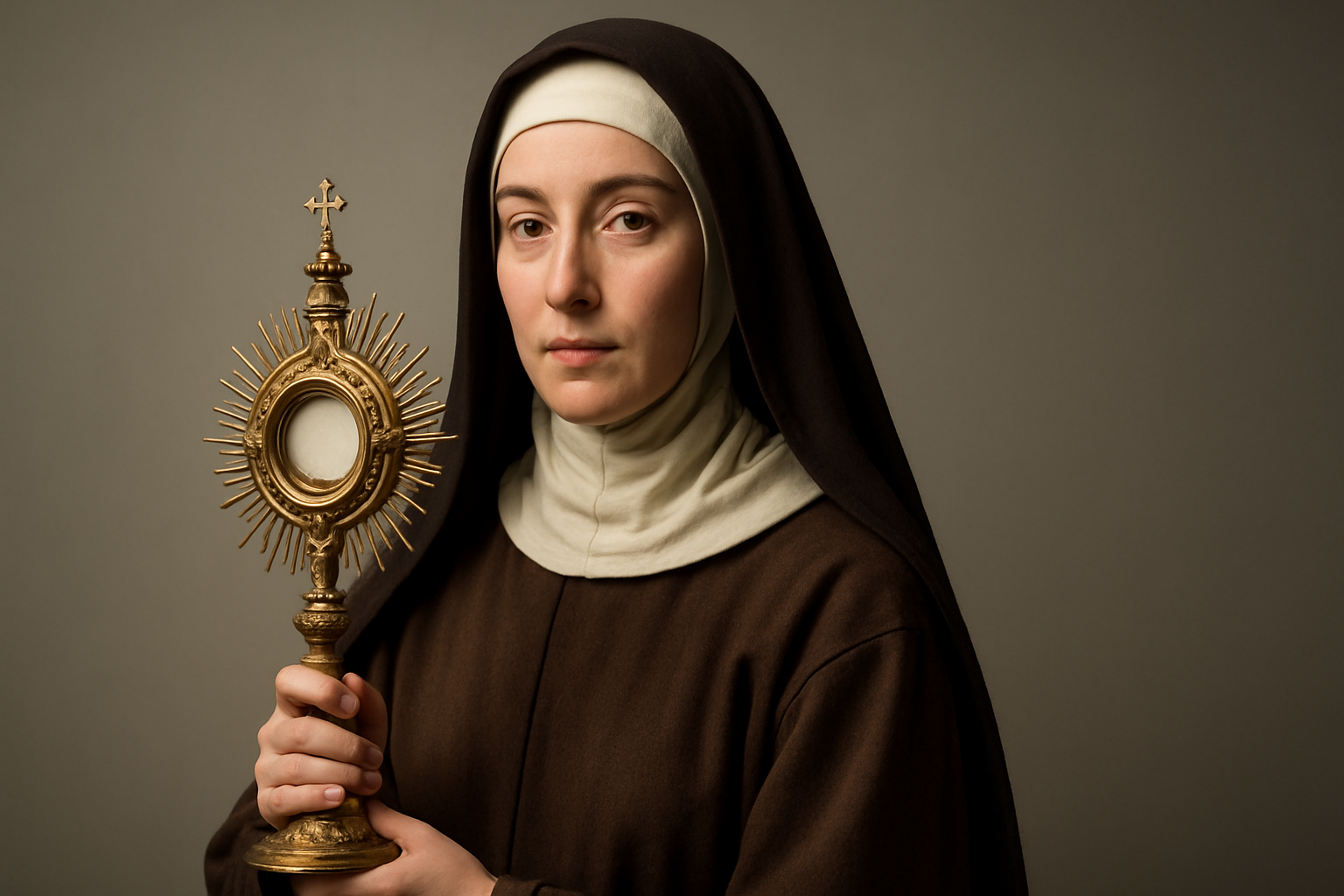
Clare’s life was also marked by several extraordinary events, showcasing her deep faith and divine favor. Perhaps the most famous incident occurred in 1240 when Saracen mercenaries, part of Emperor Frederick II’s army, attacked Assisi and threatened San Damiano. Though gravely ill, Clare had herself carried to the city wall, holding a monstrance containing the Blessed Sacrament. As she prayed, a voice from the Host reportedly told her, “I will always protect you.” The attacking soldiers were suddenly overcome with fear and fled, leaving Assisi and the convent unharmed. This event solidified her image as a protector and a woman of immense spiritual power.
For the last 29 years of her life, Clare suffered from various illnesses, often bedridden. Yet, her spirit remained indomitable. From her sickbed, she continued to govern her order, counsel her sisters, and maintain a vibrant prayer life. Her physical suffering only deepened her union with Christ, whom she called “the mirror without blemish,” and she encouraged her sisters to gaze into this mirror, transforming themselves into His image.
Letters and Spiritual Guidance
Despite her enclosure, Clare’s spiritual influence extended beyond the walls of San Damiano. She corresponded with several prominent figures, most notably Agnes of Prague, a Bohemian princess who abandoned her royal life to found a Poor Clare monastery in Prague. Clare’s four letters to Agnes are profound spiritual treatises, offering guidance on contemplative prayer, the joy of poverty, and the pursuit of holiness. These letters reveal her deep theological insight and her ability to articulate the mystical experience of union with Christ. They stand as enduring testaments to her spiritual wisdom and her role as a spiritual mother to many.
Spiritual Legacy & Theological Themes
Saint Clare’s spiritual legacy is rich and multifaceted, deeply intertwined with, yet distinct from, that of Saint Francis. Her life embodied several core virtues and theological themes that continue to resonate within the Catholic Church.
Foremost among these is her radical commitment to evangelical poverty. This was not merely about lacking possessions, but about a profound spiritual detachment from all worldly things, leading to complete trust in God’s providence. For Clare, poverty was not a deprivation but a liberation, allowing for a deeper intimacy with Christ, who Himself chose poverty. This mirrors Christ’s words in Matthew 6:24, “No one can serve two masters… You cannot serve both God and money.” Her insistence on owning nothing, relying entirely on God’s grace, makes her a powerful witness against materialism and consumerism.
Secondly, Clare exemplified the beauty and power of the contemplative life. While Franciscans were called to active preaching and service in the world, the Poor Clares lived an enclosed life, dedicated to prayer. Clare understood contemplation not as an escape from the world, but as a vital source of spiritual energy for it. Through constant prayer, adoration of the Blessed Sacrament, and meditation on Christ’s life, she believed her community could intercede for the world and draw closer to the divine. Her life echoes the sentiment of Philippians 4:6-7: “Do not be anxious about anything, but in every situation, by prayer and petition, with thanksgiving, present your requests to God. And the peace of God, which transcends all understanding, will guard your hearts and your minds in Christ Jesus.”
Clare’s devotion to the Blessed Sacrament was particularly profound, as evidenced by the miracle at San Damiano. She saw the Eucharist as the true source of strength, protection, and Christ’s enduring presence among His people. This Eucharistic piety remains a hallmark of the Poor Clares and continues to inspire devotion to Christ’s real presence in the Eucharist throughout the Church.
Finally, Clare’s life demonstrates courage and conviction in upholding her spiritual ideals. Her long struggle for the “Privilege of Poverty” shows a woman who, despite her physical frailty and societal pressures, fearlessly defended her understanding of God’s call. She was a strong leader, a spiritual mother, and a reformer who carved out a unique and lasting path for women in religious life, proving that spiritual strength can overcome immense obstacles.
Devotion Today
Saint Clare of Assisi continues to be a beloved and influential saint in the Catholic Church and beyond. Her original convent, the Basilica of Saint Clare in Assisi, Italy, remains a significant pilgrimage site. Here, visitors can venerate her relics and see the crucifix that spoke to Saint Francis. The Church of San Damiano, where Clare and her first sisters lived, is also preserved as a sacred space, offering a tangible connection to her radical life of poverty and prayer.
The Order of Poor Clares, founded by Saint Clare, has spread worldwide. With hundreds of monasteries on every continent, these enclosed contemplative communities continue to live the “Privilege of Poverty,” dedicating their lives to prayer, work, and evangelical simplicity. They are often recognized for their deep spiritual witness and their vibrant liturgical life, living quietly but powerfully at the heart of the Church.
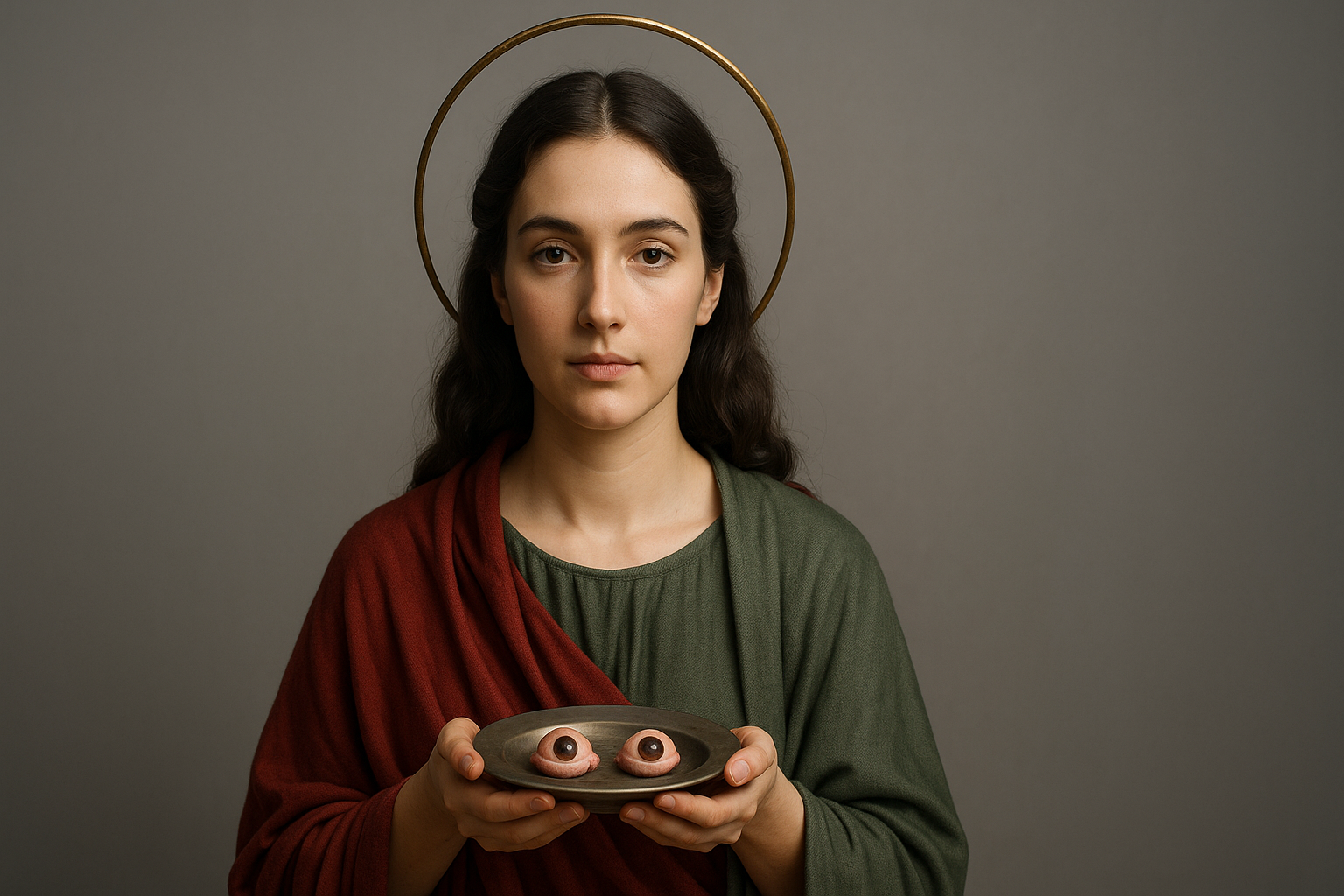
Saint Clare is widely invoked for specific intercessions. She is famously known as the patron saint of television, a patronage bestowed by Pope Pius XII in 1958 because, when she was too ill to attend Mass, she reportedly saw and heard the service on the wall of her cell. This modern patronage makes her particularly relevant in our media-saturated world. She is also the patron saint for those suffering from eye disease, embroiderers, gold workers, and good weather. Her feast day on August 11 is celebrated globally with special Masses and devotions, often highlighting her commitment to poverty and contemplative prayer.
Reflections for Modern Readers
Saint Clare’s life, though lived centuries ago, offers powerful and practical lessons for us in the 21st century:
- Embracing Simplicity in a Complex World: Clare’s radical poverty calls us to examine our own relationship with material possessions. In a consumer-driven society, her example reminds us that true joy and freedom come not from what we own, but from detachment and trust in God. We can practice this by decluttering, being mindful of our purchases, and sharing our resources with others. It’s about finding contentment in “enough” rather than constantly striving for “more.”
- The Power of Prayer and Contemplation: In a world filled with constant noise and distractions, Clare’s life of profound prayer challenges us to carve out time for quiet reflection and communion with God. Whether it’s five minutes of silent meditation, a daily rosary, or regular adoration of the Blessed Sacrament, cultivating a contemplative spirit can ground us, reduce anxiety, and deepen our relationship with the divine. Her life reminds us that even from stillness, immense spiritual power can be unleashed.
- Courage to Stand for Our Convictions: Clare, a woman of delicate health and noble birth, bravely defied societal and even ecclesiastical pressures to uphold her vision of radical poverty. Her tenacity in securing the “Privilege of Poverty” reminds us to be courageous in living out our deeply held faith convictions, even when they are unpopular or challenging. This could mean speaking up for justice, defending moral truths, or simply living authentically as a Catholic in a secular environment.
- Finding Strength in Vulnerability: Despite chronic illness and constant suffering, Clare continued to lead and inspire. Her physical weakness became a pathway to spiritual strength and reliance on God. This teaches us that our vulnerabilities and difficulties are not necessarily obstacles to holiness or service, but can be opportunities for grace, allowing Christ’s power to be made perfect in our weakness (2 Corinthians 12:9). It encourages us to lean on God, especially when we feel weakest.
In art and jewelry, Saint Clare is often depicted with a few distinct symbols that represent key aspects of her life and spirituality:
- Monstrance or Ciborium: This is her most iconic symbol, recalling the miracle where she repelled invaders by holding up the Blessed Sacrament. It signifies her profound Eucharistic devotion and trust in Christ’s presence. Many depictions show her with rays of light emanating from the monstrance.
- Lily: A common symbol of purity and virginity, the lily reflects Clare’s lifelong dedication to Christ and her chaste life, renouncing worldly marriage for spiritual union with God.
- Lamp or Lantern: Sometimes she is shown with a lamp, symbolizing her role as a spiritual guide and the light of her faith that illuminated the path for her sisters and for future generations of contemplatives.
- Simple Habit and Rope Cincture: Like St. Francis, she is often shown in the humble brown or grey habit of her order, tied with a rope cincture, emphasizing her commitment to poverty and simplicity.
Timeline Summary
- 1194: Born Chiara Offreduccio in Assisi, Italy, on July 16.
- 1211/1212: Hears Saint Francis preach during Lent, sparking her desire for a radical religious life.
- 1212: On Palm Sunday night (March 18), she leaves her family, receives the habit from Saint Francis at the Porziuncola, and makes her vows. She is briefly housed in Benedictine convents.
- 1212: Her sister Agnes joins her, and Francis establishes them at San Damiano, officially founding the Order of Poor Ladies (Poor Clares). Clare becomes their abbess.
- 1215: Pope Innocent III grants Clare the “Privilege of Poverty,” allowing her community to possess no property.
- 1224: Becomes severely ill, remaining largely confined to her bed for the remainder of her life.
- 1240: Repels Saracen invaders from San Damiano by displaying the Blessed Sacrament.
- 1253: On August 9, Pope Innocent IV approves her Rule, confirming the “Privilege of Poverty.”
- 1253: Dies on August 11 at San Damiano.
- 1255: Canonized by Pope Alexander IV on August 15, just two years after her death.
- 1958: Declared Patroness of Television by Pope Pius XII.
Scripture for Reflection
Saint Clare’s life beautifully reflects several biblical truths, particularly concerning poverty, prayer, and trust in God:
- Matthew 6:24-25, 33-34 (On Trust and Priorities): “No one can serve two masters. Either you will hate the one and love the other, or you will be devoted to the one and despise the other. You cannot serve both God and money. Therefore I tell you, do not worry about your life, what you will eat or drink; or about your body, what you will wear… But seek first his kingdom and his righteousness, and all these things will be given to you as well. Therefore do not worry about tomorrow, for tomorrow will worry about itself. Each day has enough trouble of its own.” Clare lived this trust fully, refusing to allow her community to hold possessions, relying entirely on God’s provision.
- Luke 10:38-42 (On the Better Part – Contemplation): “As Jesus and his disciples were on their way, he came to a village where a woman named Martha opened her home to him. She had a sister called Mary, who sat at the Lord’s feet listening to what he said. But Martha was distracted by all the preparations that had to be made. She came to him and asked, ‘Lord, don’t you care that my sister has left me to do the work by myself? Tell her to help me!’ ‘Martha, Martha,’ the Lord answered, ‘you are worried and upset about many things, but few things are needed—or indeed only one. Mary has chosen what is better, and it will not be taken away from her.'” Clare’s contemplative life, dedicated to sitting at the Lord’s feet in prayer, perfectly embodies choosing “the better part.”
- Psalm 62:5-8 (On Trust in God Alone): “Yes, my soul, find rest in God; my hope comes from him. Truly he is my rock and my salvation; he is my fortress, I will not be shaken. My salvation and my honor depend on God; he is my mighty rock, my refuge. Trust in him at all times, you people; pour out your hearts to him, for God is our refuge.” Clare’s life was a testament to this psalm, particularly during her long illness and the struggle for her Rule, where she found her strength and refuge solely in God.
Prayers to Saint Clare
Here are a few prayers honoring Saint Clare and seeking her intercession:
A Prayer for the Intercession of Saint Clare:
O glorious Saint Clare,
you who loved Jesus with an ardent heart,
and chose a life of radical poverty and contemplation,
we turn to you in our needs.
You who protected your city by the power of the Blessed Sacrament,
be our shield against all dangers,
both spiritual and physical.
Intercede for us, we pray,
that we may detach our hearts from worldly desires,
and fix our gaze on Christ, the mirror without blemish.
Grant us the grace to embrace simplicity,
to persevere in prayer, and to trust wholeheartedly in God’s loving providence,
especially in times of suffering and uncertainty.
Through your powerful intercession,
may we, like you, live lives that reflect the Gospel,
and one day join you in eternal joy with our Lord. Amen.
Short Prayer to Saint Clare (Patroness of Television):
Dear Saint Clare, Patroness of Television,
you who saw Mass across time and space through divine grace,
guide us to use modern media wisely and for God’s glory.
Help us to discern truth, to promote goodness, and to find beauty
in the images and stories we encounter.
May our screens reflect God’s light,
and may we always remember the true presence of Christ
in our lives. Amen.