In the vast tapestry of Catholic saints, some stories shine with a particular brilliance, not just for their heroic deeds but for the profound lessons they offer humanity. One such radiant example is Saint Maria Goretti, a young girl whose life, though tragically short, became a powerful testament to purity, forgiveness, and unwavering faith. Her story, set in the turn of the 20th century Italian countryside, continues to inspire millions, offering a beacon of hope and a challenge to embrace holiness even in the face of profound evil. This article will delve into her humble beginnings, the dramatic events of her martyrdom, her enduring spiritual legacy, and how her courageous witness remains relevant for us today.
Quick Facts
| Detail | Information |
|---|---|
| Birth | October 16, 1890 |
| Death | July 6, 1902 |
| Feast Day | July 6 |
| Patronage | Purity, children, victims of sexual assault, youth |
| Canonized | June 24, 1950 |
Historical Context & Early Life
Maria Goretti was born into deep poverty in Corinaldo, Italy, on October 16, 1890. Her life unfolded at a time when Italy, newly unified, still wrestled with significant social and economic disparities, particularly in its rural areas. Farming families, like the Gorettis, often worked as sharecroppers, meaning they leased land and paid a portion of their harvest as rent, leaving them with very little. Life was arduous, marked by physical labor, scant resources, and a constant struggle for survival. Despite these hardships, faith remained a central pillar of family life for many, offering solace and strength in challenging times.
Maria was the third of seven children born to Luigi and Assunta Goretti. Her family was devout, instilling in her from a very young age a deep love for God and the practices of the Catholic faith. The values of honesty, hard work, and prayer were woven into the fabric of their daily existence. Maria’s childhood was typical for a rural Italian girl of her era: simple, focused on family, and immersed in the rhythms of agricultural life. She attended catechism classes diligently, eagerly preparing for her First Communion, a momentous occasion for any Catholic child, representing their first intimate encounter with Jesus in the Eucharist. This spiritual foundation would prove to be her anchor in the trials to come.
Tragedy struck the family when Maria was just nine years old. Her father, Luigi, contracted malaria and died, leaving his wife, Assunta, to care for six young children (one infant had already died). This immense loss forced the family to move, seeking better opportunities. They found a shared farm with the Serenelli family in Ferriere di Conca, a hamlet near Nettuno. Living in close quarters with another family, especially under such strained circumstances, introduced new challenges and tensions into Maria’s already difficult life.
Calling & Key Milestones
Maria Goretti’s “calling” wasn’t to a religious order or a life of grand public ministry, but to a profound witness of Christian virtue in the most extreme circumstances. Her story is one of a young girl’s simple, yet heroic, commitment to God’s law.
First Communion: A Deepening Faith
One of the most significant milestones in Maria’s brief life was her First Communion. She received this sacrament in 1902, just months before her death. Despite the family’s poverty and the difficulty of finding proper attire, Maria’s desire to receive Jesus was immense. She eagerly studied her catechism and understood the sacredness of the Eucharist. This event was not merely a ritual for her; it was a profound spiritual experience that deepened her relationship with God and strengthened her resolve to live a life pleasing to Him. Her First Communion laid a strong spiritual foundation that would empower her final, heroic act.
The Act of Heroic Purity and Martyrdom
The defining moment of Maria’s life occurred on July 5, 1902. At the age of eleven, Maria was alone in the family’s shared farmhouse, mending clothes, while her family members were out working in the fields. Alessandro Serenelli, a nineteen-year-old neighbor and son of the co-tenant, approached her. He had previously made inappropriate advances towards Maria, which she had resisted, knowing them to be sinful. On this fateful day, Alessandro demanded that Maria surrender to his desires. Maria, acutely aware of the sanctity of her purity and God’s law, refused him repeatedly, crying out, “No! It is a sin! God does not want it! You will go to hell!”
Enraged by her resistance, Alessandro attacked her, stabbing her multiple times with a sharpened awl, a tool used in shoemaking. Maria fought back, not just physically, but spiritually, defending her dignity and her soul. Her final words, even as she bled profusely, were a plea for Alessandro to stop, reminding him of God’s judgment. She was rushed to the hospital but died the following day, July 6, 1902, after forgiving her attacker.
Forgiveness from Her Deathbed
Perhaps the most extraordinary aspect of Maria’s martyrdom was her act of forgiveness. As she lay dying in the hospital, in immense pain, she was asked if she forgave Alessandro. Without hesitation, Maria declared, “Yes, for the love of Jesus, I forgive him… I want him to be with me in Paradise.” This act of Christ-like charity, extending forgiveness to the person who had violently ended her life, elevated her martyrdom from a mere tragedy to a profound witness of Christian love and mercy. It was this radical forgiveness that truly captivated the Church and the world.
Spiritual Legacy & Theological Themes
Maria Goretti’s brief life, culminating in her heroic death, left an indelible mark on Catholic spirituality, especially concerning the virtues of purity and forgiveness. Her story embodies several core theological themes that continue to resonate deeply.
The most prominent virtue Maria exemplified was **purity**. In an age that often trivializes sexual morality, Maria’s unwavering commitment to chastity, even unto death, stands as a powerful counter-cultural witness. Her purity was not merely a physical state but an inner disposition, a profound respect for the sanctity of the human body as a temple of the Holy Spirit. She understood that true human dignity is found in honoring God’s design for love and life. Her defiance against Alessandro was not out of hatred for him, but out of a deep love for God and for herself, understanding that to compromise her purity would be to compromise her very soul. This heroic purity reminds us that modesty and chastity are not outdated concepts but pathways to authentic freedom and spiritual integrity.
Closely intertwined with her purity is the theme of **martyrdom**. Maria is considered a martyr of purity, meaning she died not just for her faith in general, but specifically for upholding a Catholic moral teaching. Her death highlights the Church’s belief that some truths are worth dying for, and that defending one’s spiritual integrity against grave sin, even at the cost of one’s life, is a path to sainthood. Her blood became a seed of grace, bearing fruit not only in her own glorification but also in the transformation of her killer.
Perhaps the most breathtaking aspect of Maria’s legacy is her **radical forgiveness**. Her dying words, “I forgive Alessandro,” are a profound echo of Christ’s prayer from the cross: “Father, forgive them, for they know not what they do” (Luke 23:34). This act of mercy transformed her martyrdom into a powerful witness to the divine mercy that is at the heart of the Christian faith. It teaches us that forgiveness is not just about releasing the offender from punishment, but about releasing oneself from the chains of bitterness and hate, and opening the door for God’s grace to work miracles, even in the most hardened hearts. Alessandro Serenelli himself testified to a profound spiritual conversion years later, attributing it directly to a vision of Maria and her forgiveness. He eventually joined a Capuchin monastery as a lay brother, living out his repentance and devotion to Maria.
Maria Goretti also embodies the theme of **youthful holiness**. Her sainthood proves that holiness is not reserved for the old or the educated, but is accessible to all, regardless of age, social status, or intellectual capacity. She was a simple, uneducated farm girl, yet she grasped the essence of Christian love and moral truth with a clarity that many adults struggle to attain. Her life encourages young people to take their faith seriously and to strive for virtue in their daily lives.
Her lasting influence is seen in the continued **devotion to purity and chastity** within the Church, especially among youth movements and educational programs. She serves as a patron for those who have suffered abuse, offering them a patron saint who understands their pain and inspires them to seek healing and, eventually, forgiveness. Her story also fortifies the Church’s teaching on the dignity of every human person and the sanctity of life from conception to natural death, asserting that no one has the right to violate another’s body or soul.
Devotion Today
Devotion to Saint Maria Goretti remains strong around the world, particularly in Italy and among communities dedicated to promoting purity and supporting victims of violence. Her story, infused with both tragedy and triumphant grace, continues to draw pilgrims and inspire prayers.
The primary site of devotion is the **Shrine of Saint Maria Goretti in Nettuno, Italy**, where her body rests in the Basilica of Our Lady of Graces and Saint Maria Goretti. Pilgrims visit this basilica to pray at her tomb, seek her intercession, and reflect on her courageous life. A small museum nearby displays artifacts from her life, including the clothes she wore and the awl used in the attack, serving as stark reminders of her sacrifice and the profound grace that transformed her story.
Her feast day, **July 6th**, is celebrated globally, often with special Masses and prayer services. Many parishes and religious communities, particularly those involved in youth ministry or support for abuse survivors, honor her on this day, reflecting on her virtues and seeking her intercession. She is a popular patron for purity pledges and chastity movements among young Catholics.
Maria Goretti is also particularly revered by various **youth groups and organizations** that focus on moral formation and spiritual development. Retreats, talks, and educational materials often highlight her story as an example of integrity and the beauty of Christian virtue. Her narrative is simple enough for children to grasp, yet profound enough to challenge adults.
Beyond formal shrines, Maria Goretti’s image and story are widespread in **personal devotion**. Many individuals pray novenas to her, especially those seeking strength to uphold purity, battling temptation, or working through the difficult process of forgiveness. Her intercession is also sought by those who have suffered trauma or abuse, as she is seen as a powerful advocate for healing and peace.
Reflections for Modern Readers
Saint Maria Goretti’s story, though set over a century ago in a rural Italian village, offers timeless lessons that are profoundly relevant to the challenges and opportunities of the 21st century. Her short life speaks volumes about dignity, choice, and the transformative power of grace.
1. **Embrace True Freedom by Upholding Personal Dignity:** In a world that often confuses freedom with license, Maria reminds us that true freedom lies in choosing what is good and upholding one’s inherent dignity, even when pressured. Her refusal to compromise her purity was an act of profound self-respect and allegiance to God’s loving law. For modern readers, this translates into resisting societal pressures to conform to unhealthy trends, whether in relationships, media consumption, or ethical choices. It’s about recognizing that our bodies and souls are sacred, created in God’s image, and deserve to be honored and protected.
2. **The Power of Forgiveness, Even the Unimaginable:** Maria’s dying act of forgiving her attacker is arguably the most radical and challenging aspect of her legacy. In an age marked by division, retribution, and a struggle with reconciliation, Maria shows us that forgiveness is not weakness but immense strength, mirroring Christ’s own mercy on the cross. For anyone holding onto bitterness, anger, or resentment, her story is a call to release that burden, not just for the sake of the other, but for one’s own spiritual freedom and healing. It’s a testament to the transformative power of God’s grace working through human hearts.
3. **Holiness is for Everyone, Everywhere:** Maria was not a queen, a scholar, or a founder of a religious order. She was a simple, uneducated peasant girl. Yet, she became a saint because she lived the Christian virtues heroically in her everyday life. This teaches us that sainthood isn’t an elite club but a universal call. No matter our age, background, or profession, we are all called to be saints by striving for holiness in our ordinary circumstances, whether in school, at work, or within our families. Her story simplifies the path to heaven: love God, love neighbor, and defend what is good.
4. **Courage in the Face of Adversity:** Maria Goretti faced extreme adversity – poverty, loss of her father, and ultimately, violent attack. Her courage was not born of physical strength, but spiritual resolve. She chose goodness and truth even when it cost her everything. This inspires us to cultivate moral courage in our own lives, to stand up for what is right, to defend the vulnerable, and to speak truth with charity, even when it is unpopular or difficult.
5. **The Value of Sacramental Life:** Maria’s profound desire for her First Communion and her understanding of the Eucharist underscore the vital importance of the sacraments in strengthening our spiritual lives. Regular participation in the Eucharist and Reconciliation (confession) provides the grace necessary to face life’s challenges and grow in holiness. Her story reminds us that these encounters with Christ are not mere rituals but encounters with divine power that equip us for spiritual warfare and daily living.
Common symbols and representations of Saint Maria Goretti in art and jewelry often include:
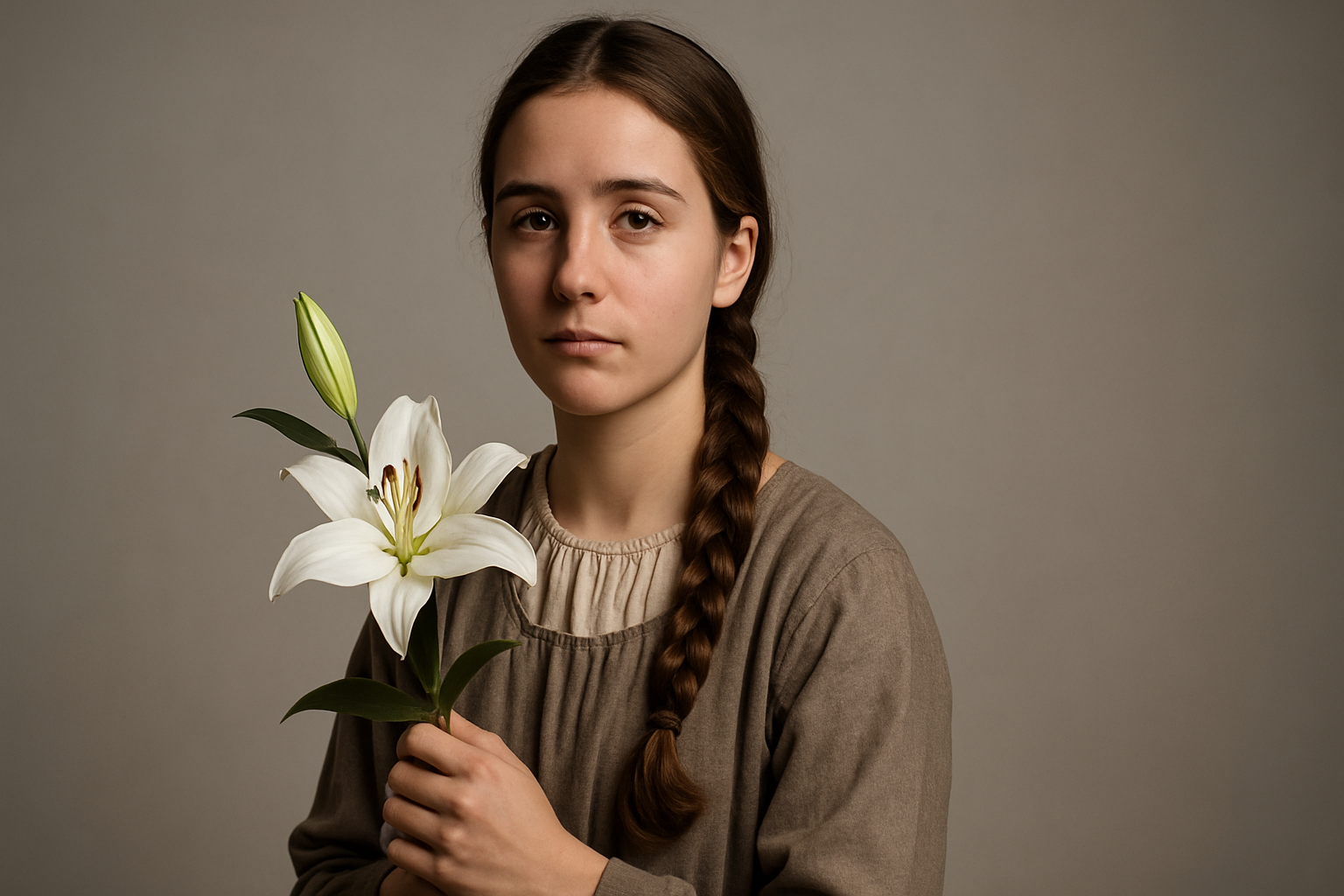
- **Lilies:** These white flowers symbolize purity and innocence, reflecting Maria’s heroic chastity.
- **Palm Branch:** This is a universal symbol of martyrdom, representing victory over death through faith.
- **The Awl or Knife:** While disturbing, this sometimes appears in art to signify the instrument of her martyrdom, emphasizing the violence she endured for her faith.
- **Young Girl in Simple Clothes:** She is almost always depicted as a young, humble girl, often with a serene expression, symbolizing her youth and her simple, yet profound, holiness.
Timeline Summary
- **October 16, 1890:** Maria Teresa Goretti is born in Corinaldo, Ancona, Italy.
- **1899:** Maria’s father, Luigi Goretti, dies of malaria. The family is forced to move to Ferriere di Conca to share a farm with the Serenelli family.
- **Spring 1902:** Maria receives her First Holy Communion, deepening her spiritual resolve.
- **July 5, 1902:** Alessandro Serenelli, a nineteen-year-old, attacks Maria in her home. Maria resists, choosing purity over compliance. She is mortally wounded by multiple stabs.
- **July 6, 1902:** Maria Goretti dies in the hospital at Nettuno, after forgiving her attacker, Alessandro Serenelli.
- **1910:** Alessandro Serenelli is released from prison after serving 27 years. He has a profound conversion experience, which he attributes to a vision of Maria Goretti.
- **1929:** Alessandro Serenelli publicly begs forgiveness from Assunta Goretti, Maria’s mother, at the Church of Nettuno.
- **1938:** The process for Maria’s canonization officially begins.
- **April 27, 1947:** Pope Pius XII beatifies Maria Goretti, declaring her “Blessed.”
- **June 24, 1950:** Pope Pius XII canonizes Maria Goretti, declaring her a saint in an outdoor ceremony in St. Peter’s Square, with her mother, Assunta, present.
Scripture for Reflection
Saint Maria Goretti’s life beautifully illuminates several biblical truths, particularly concerning purity, forgiveness, and the strength found in God’s grace.
On Purity and Holiness:
“Do you not know that your body is a temple of the Holy Spirit within you, whom you have from God, and that you are not your own? For you were bought with a price; therefore glorify God in your body.” (1 Corinthians 6:19-20)
Maria understood this truth profoundly. She recognized that her body was not merely her own but belonged to God, and she fiercely defended its sanctity. Her actions were a powerful testament to glorifying God in her body, even at the cost of her life, embodying the very essence of purity as a temple of the Holy Spirit.
On Forgiveness:
“But I say to you, love your enemies and pray for those who persecute you, so that you may be sons of your Father who is in heaven; for he makes his sun rise on the evil and on the good, and sends rain on the just and on the unjust.” (Matthew 5:44-45)
Maria’s dying act of forgiving Alessandro is a direct echo of Jesus’ teaching on loving one’s enemies. Her ability to extend mercy to her attacker, even in immense suffering, showcases a supernatural love that truly mirrors the boundless love and forgiveness of our Heavenly Father. It’s a challenging call, but Maria’s life demonstrates that with God’s grace, such radical forgiveness is possible.
On Courage and Trust in God:
“The Lord is my light and my salvation; whom shall I fear? The Lord is the stronghold of my life; of whom shall I be afraid?” (Psalm 27:1)
Despite her youth and small stature, Maria displayed immense courage. Her fear of God and of sin was greater than any fear of man or suffering. Her unwavering trust in the Lord as her stronghold enabled her to stand firm in her convictions, embodying the truth that with God, we need not be afraid, even when facing death.
Prayers to Saint Maria Goretti
Here are a few prayers invoking the intercession of Saint Maria Goretti, often prayed for purity, forgiveness, and strength in trials.
Prayer for Purity (Simple Prayer):
O Saint Maria Goretti, who, strengthened by God’s grace, did not hesitate, even at the age of eleven, to shed your blood to defend your virginal purity, look mercifully on the human race, which has strayed far from the way of eternal salvation. Inspire us with a love for purity, humility, and the holy fear of God. Help us to resist temptations and to grow in virtue, that we too may one day enjoy the presence of God with you in heaven. Amen.
Prayer for Strength and Forgiveness:
Dear Saint Maria Goretti, brave young martyr of purity, you died forgiving your attacker, becoming a radiant example of Christian mercy. Look down upon us with compassion and intercede for us before the throne of God. We pray for all who struggle with impurity, that they may find strength to resist temptation and choose the path of holiness. We also pray for those who have been hurt and for their attackers, that hearts may be softened and forgiveness may triumph over hatred and bitterness. Inspire us to love as Christ loves, to forgive as Christ forgives, and to live with unwavering faith in His divine mercy. Amen.
Novena Prayer to Saint Maria Goretti (Day 1 – adapted for brevity):
O Saint Maria Goretti, who from your earliest years did lead a life of intense prayer and great love for God and neighbor. Your heart was filled with peace and strength due to the frequent reception of the Sacraments. We ask you to obtain for us from our Lord Jesus Christ a great love for purity and the grace to overcome all temptations that may lead us to offend God. Obtain for us, too, a sincere spirit of forgiveness toward those who have wronged us, and the grace to be truly reconciled with God. Help us to walk always in the path of holiness and to trust in God’s mercy as you did. Amen. (Continue with Our Father, Hail Mary, Glory Be)