In the vibrant, often turbulent, landscape of 20th-century El Salvador, a quiet man named Oscar Arnulfo Romero found his voice, transforming from a seemingly conservative bishop into a fearless advocate for the poor and oppressed. His life, marked by profound spiritual conversion and ultimate martyrdom, stands as a powerful testament to courageous faith and love for justice. This article will explore Saint Oscar Romero’s journey, from his humble beginnings to his prophetic ministry, his lasting legacy, and the deep lessons his life offers to believers today.
Quick Facts
| Category | Detail |
|---|---|
| Birth | August 15, 1917, Ciudad Barrios, El Salvador |
| Death | March 24, 1980, San Salvador, El Salvador (Martyred) |
| Feast Day | March 24 |
| Patronage | Caritas, human rights, martyrs, El Salvador, persecuted Christians |
| Canonized | October 14, 2018, by Pope Francis |
Historical Context & Early Life
Oscar Arnulfo Romero y Galdámez was born into a large, humble family in Ciudad Barrios, a small town in eastern El Salvador. His father was a telegrapher, and his mother managed the household. El Salvador in the early to mid-20th century was a nation grappling with immense social inequality. A small elite controlled most of the land and wealth, while the vast majority of the population, particularly rural farmers, lived in deep poverty. This stark disparity often led to widespread unrest, political instability, and brutal repression by the government and military, often backed by the powerful landowners.
From a young age, Oscar showed signs of deep piety and intellectual curiosity. He initially apprenticed as a carpenter, but at the age of 13, he felt a strong calling to the priesthood. He entered the minor seminary in San Miguel and later continued his studies at the National Seminary in San Salvador. His academic journey culminated in Rome, where he studied theology at the Gregorian University, earning a licentiate in theology. This period in Rome, steeped in intellectual rigor and traditional Catholic thought, shaped his early theological perspectives, which were generally seen as orthodox and conservative.
Returning to El Salvador in 1943, Father Romero began his priestly ministry. He served in various capacities, including parish priest, seminary rector, and secretary of the bishops’ conference. He also became known for his powerful radio sermons, which reached many Salvadorans and established him as a respected, if somewhat traditional, voice within the Church. Throughout these years, he was known for his dedication, his meticulous adherence to Church doctrine, and his pastoral care for the people.
Calling & Key Milestones
Early Priesthood and Episcopal Appointments
For decades, Oscar Romero diligently served the Church in El Salvador. His reputation was that of a pious, hardworking, and doctrinally sound priest. He moved up the ecclesiastical ladder, first as an auxiliary bishop of San Salvador in 1970, and then as Bishop of Santiago de María in 1974. In these roles, he was seen as a safe, moderate choice by both the Church hierarchy and the Salvadoran government, who often viewed socially progressive clergy with suspicion. He was not known for radical pronouncements or direct confrontation with the political powers.
Archbishop of San Salvador: A Profound Conversion
On February 3, 1977, Bishop Romero was appointed Archbishop of San Salvador, the highest ecclesiastical position in El Salvador. Many, including the government and conservative factions within the Church, believed his appointment would bring a more tranquil and less politically engaged leadership to the Archdiocese, which had become increasingly vocal about human rights abuses. However, just weeks into his new role, a pivotal event shattered this expectation and ignited a profound spiritual transformation in Archbishop Romero.
On March 12, 1977, his close friend, Father Rutilio Grande, a Jesuit priest known for his work among the rural poor and his advocacy for their rights, was brutally assassinated by a government-affiliated death squad. Father Grande had been working to organize the campesinos (farmers) and promote social justice, aligning with the Church’s “option for the poor.” His murder deeply shocked Archbishop Romero. He saw in Father Grande’s death a clear sign of the grave injustice and violence plaguing his nation and a direct attack on the Church’s mission to serve the vulnerable.
This tragic event marked a profound personal conversion for Archbishop Romero. He later reflected, “When I looked at Rutilio lying there dead, I thought, ‘If they have killed him for doing what I should do, then I, too, have to walk the same path.'” He suddenly understood that his pastoral duty demanded more than traditional piety; it required him to stand unequivocally with the poor and persecuted, even at great personal risk.
Voice for the Voiceless
Following Father Grande’s assassination, Archbishop Romero became a fearless advocate for human rights and a fierce critic of the government’s repression. His Sunday homilies, broadcast nationwide via radio, became a lifeline of truth and hope for many. He denounced disappearances, tortures, murders, and economic exploitation, naming the victims and the perpetrators when he could. He bravely called on the government to cease its violence and implored the military to stop killing its own people, even reminding soldiers that their highest loyalty was to God, not to unjust orders.
His unwavering commitment to justice earned him both immense love from the poor and fierce hatred from the powerful. He was called a communist, a revolutionary, and an agitator. Yet, he continued to preach the Gospel in its fullness, emphasizing the Church’s mission to defend human dignity and challenge systems of oppression. He understood that true peace could only be built on justice.
Martyrdom
Archbishop Romero knew his life was in danger. He received numerous death threats, and his close collaborators urged him to take precautions. Yet, he refused to abandon his flock or compromise his prophetic message. He famously declared, “If they kill me, I shall rise again in the Salvadoran people.” On March 24, 1980, while celebrating Mass in the chapel of the Hospital of Divine Providence, he was shot and killed by an assassin’s bullet. His death sent shockwaves across El Salvador and the world, cementing his status as a martyr for justice and faith.
Spiritual Legacy & Theological Themes
Saint Oscar Romero’s spiritual legacy is primarily defined by his profound commitment to the “option for the poor,” a core principle of Catholic social teaching that emphasizes prioritizing the needs of the most vulnerable in society. He didn’t just speak about this option; he lived it, aligning himself fully with those suffering from poverty and injustice. He taught that defending the poor was not a political act but a profoundly Gospel-driven one, rooted in Christ’s own identification with the marginalized (Matthew 25:31-46).
He exemplified the virtue of **prophetic witness**, speaking truth to power even when it meant facing severe opposition and ultimately death. His sermons were not abstract theological reflections but concrete condemnations of specific acts of violence and injustice, grounded in Scripture and the Church’s call to charity. He demonstrated that true faith demands action and a willingness to challenge societal norms that deny human dignity.
Romero also stands as a powerful symbol of **martyrdom**, not just death for faith, but death as a consequence of living out the Gospel’s demands for justice and love. His sacrifice underscored the Church’s teaching that true discipleship can sometimes demand the ultimate witness of one’s life.
His influence extends to Catholic theology, particularly in the realm of liberation theology, which seeks to interpret Christian faith through the experiences of the poor and oppressed. While Romero himself was not a theologian in the academic sense, his lived experience and pastoral practice profoundly illustrated the principles of integral human development and the pursuit of justice as a constitutive dimension of the Gospel.
Devotion Today
Devotion to Saint Oscar Romero has grown significantly since his martyrdom. His tomb in the Metropolitan Cathedral of San Salvador is a popular pilgrimage site, drawing visitors from around the world who come to honor his memory and seek his intercession. He is revered by countless individuals, particularly in Latin America, as a saint who understood and shared their struggles for justice and dignity.
He was beatified on May 23, 2015, and canonized by Pope Francis on October 14, 2018, formally recognizing his holiness and his martyrdom “in hatred of the faith.” His feast day, March 24, is observed globally, often with special liturgies and events that reflect on themes of justice, peace, and human rights. He is a powerful intercessor for those working for social justice and for communities facing oppression.
Reflections for Modern Readers
Saint Oscar Romero’s life offers profound and actionable lessons for us in the 21st century:
- Speaking Truth to Power: Romero reminds us that faith is not meant to be confined to private devotion. It calls us to speak out against injustice, even when it’s uncomfortable or risky. In a world grappling with inequality, prejudice, and human rights abuses, his example encourages us to find our voice and advocate for the vulnerable, whether in our local communities or on a global scale.
- The Power of Personal Conversion: His transformation from a cautious bishop to a prophetic voice demonstrates that it’s never too late to deepen our faith and respond more fully to God’s call. It encourages us to be open to how God might challenge our assumptions and lead us to uncomfortable truths, particularly about those suffering.
- Love of Neighbor as Practical Action: For Romero, loving one’s neighbor wasn’t just a feeling; it was a commitment to seeking their welfare, defending their rights, and alleviating their suffering. This calls us to move beyond passive sympathy to active compassion, engaging in concrete actions to help those in need, whether through charitable work, advocacy, or standing in solidarity with the marginalized.
- Courage in the Face of Adversity: Romero’s unwavering resolve despite death threats inspires us to cultivate courage in our own lives. We may not face physical martyrdom, but we often face social pressure, criticism, or fear when standing up for our beliefs. His life teaches us to trust in God’s strength and to prioritize divine will over human fear.
- The Cost of Discipleship: His martyrdom serves as a stark reminder that following Christ can sometimes come at a great cost. It challenges us to examine our own willingness to sacrifice for our faith and for the sake of God’s kingdom, reminding us that true discipleship may require us to step outside our comfort zones.
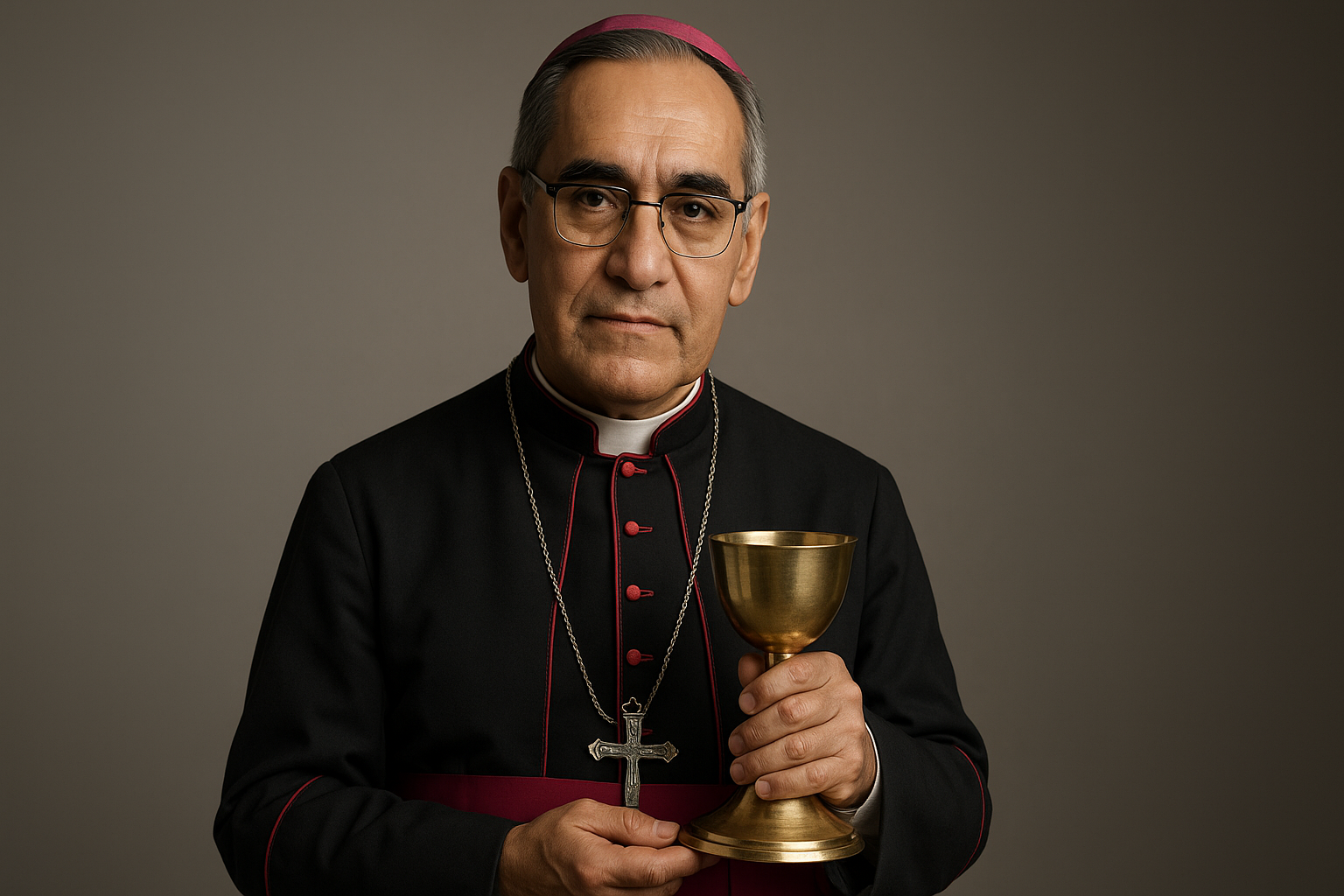
In art and jewelry, Saint Oscar Romero is often depicted in his bishop’s attire, sometimes with a microphone symbolizing his powerful radio homilies that reached the masses. You might also see him with a chalice, representing his priestly ministry and his martyrdom during Mass, or with a cross, a universal symbol of Christian sacrifice. Occasionally, images might subtly include references to the Salvadoran flag or landscape. These symbols collectively represent his pastoral care, his prophetic voice, and his ultimate sacrifice for justice.
Timeline Summary
- August 15, 1917: Born in Ciudad Barrios, El Salvador.
- 1930: Enters minor seminary at age 13.
- 1937: Travels to Rome for theological studies.
- April 4, 1942: Ordained a priest in Rome.
- 1943: Returns to El Salvador, begins pastoral work.
- 1970: Appointed Auxiliary Bishop of San Salvador.
- 1974: Appointed Bishop of Santiago de María.
- February 3, 1977: Appointed Archbishop of San Salvador.
- March 12, 1977: Father Rutilio Grande, a close friend, is assassinated, marking Romero’s spiritual conversion.
- 1977-1980: Becomes a vocal critic of the Salvadoran government’s human rights abuses, delivering powerful, widely broadcast homilies.
- March 24, 1980: Martyred while celebrating Mass.
- May 23, 2015: Beatified by Pope Francis.
- October 14, 2018: Canonized as a saint by Pope Francis.
Scripture for Reflection
Saint Oscar Romero’s life perfectly embodies several scriptural truths, especially regarding justice and love for the poor.
Matthew 25:40: “And the King will say, ‘I tell you the truth, whatever you did for one of the least of these brothers and sisters of mine, you did for me.'” This verse powerfully encapsulates Romero’s ministry. He saw Christ in the faces of the suffering poor and acted on their behalf, understanding that service to them was service to God Himself.
Isaiah 58:6-7: “Is not this the fast that I choose: to loose the bonds of injustice, to undo the thongs of the yoke, to let the oppressed go free, and to break every yoke? Is it not to share your bread with the hungry, and bring the homeless poor into your house; when you see the naked, to cover them, and not to hide yourself from your own kin?” This prophetic passage from Isaiah highlights the kind of “true worship” God desires: one that actively seeks justice and cares for the marginalized. Romero lived this prophetic call, prioritizing concrete action for the oppressed over mere ritual.
John 15:13: “Greater love has no one than this: to lay down one’s life for one’s friends.” Saint Oscar Romero truly lived this verse. He continued his ministry and spoke out against injustice knowing full well the risks, ultimately giving his life for his people, whom he considered his friends and flock. His martyrdom is the ultimate act of self-giving love.
Prayers to Saint Oscar Romero
Here are a couple of prayers associated with Saint Oscar Romero, reflecting on his life and legacy:
Prayer for Justice and Peace (inspired by Romero):
God of Justice, through your servant Saint Oscar Romero, you taught us that love for the poor and justice for the oppressed are at the heart of the Gospel. We pray for the courage to be a voice for the voiceless, to challenge systems of injustice, and to work tirelessly for a world where all your children can live in dignity and peace. Inspire us, like Saint Oscar, to dedicate our lives to the integral liberation of all people, building your Kingdom on Earth. Through Christ our Lord. Amen.
A Short Prayer for Courage:
Saint Oscar Romero, martyred shepherd of El Salvador, you embraced your cross for the sake of justice and truth. Intercede for us, that we may have your courage to defend the vulnerable, speak truth to power, and love our enemies. Help us to be faithful disciples of Christ, even when the path is difficult. Amen.